

The most common causes of hypochromic microcytic anemia are the following:
- Iron deficiency anemia
- Thalassemia
- Sideroblastic anemias (hereditary or acquired secondary to a toxic effect such as lead poisoning, or drugs)
- Severe anemia of chronic disease
Hemoglobin Disorders Due to Altered Globin Chain Synthesis
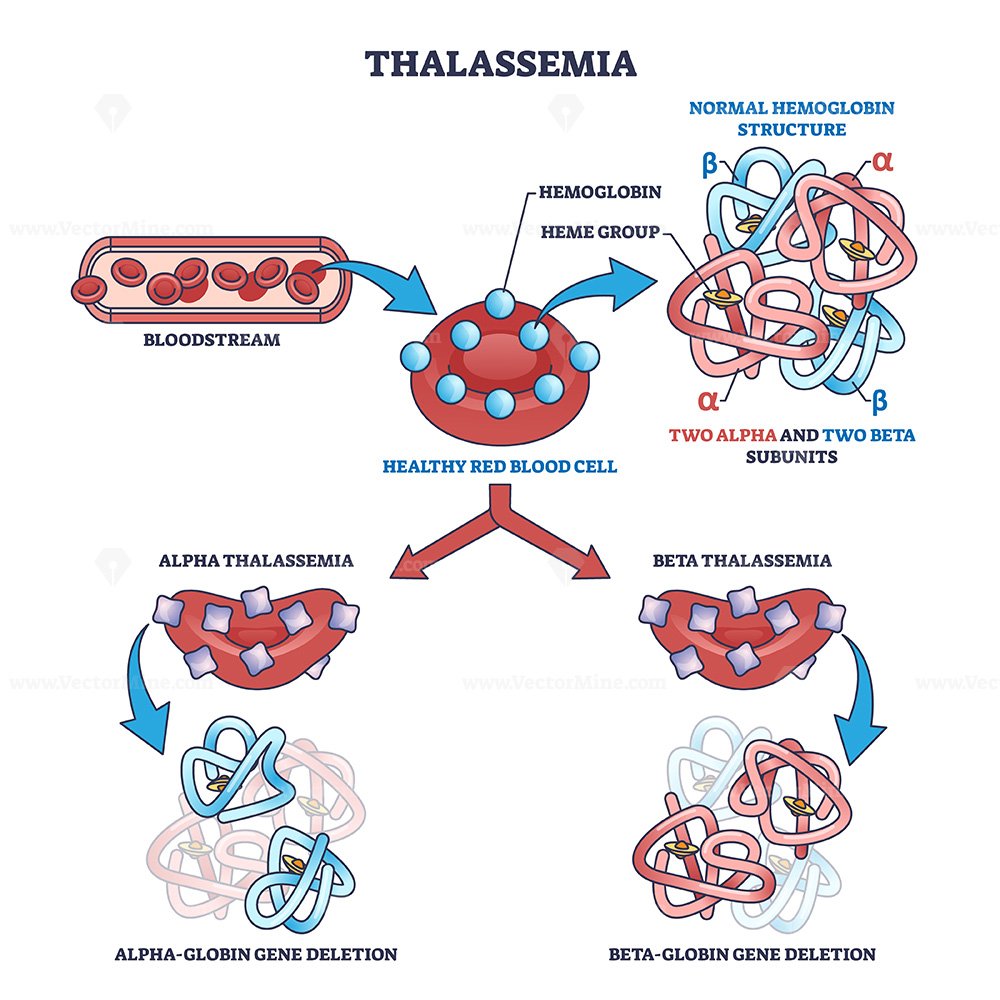
The main function of hemoglobin in red blood cells is to carry oxygen from the lungs to tissue. Hemoglobin is composed of the following:
- 4 globin chains (2 alpha chains and 2 other chains)
- 4 heme groups (iron and protoporphyrin)
- 4 oxygen molecules
The heme and globin chains are made in the RBC cytoplasm. The two alpha chains remain constant throughout life, while the other chain type switches during development. At birth, gamma chains predominate to form fetal hemoglobin, Hb F (alpha 2, gamma 2). After approximately one year of age, the main type of hemoglobin (>95%) becomes adult Hb A, composed of two α and two beta chains (alpha 2, beta 2).
Two main types of disorders result from abnormalities in globin chain synthesis. These include the following:
- Hemoglobinopathies – production of structurally different hemoglobin than normally seen. Hemoglobins that cause the most clinical problems are usually the result of a genetic mutation in the beta-globin gene that leads to a structurally different globin chain. Examples include: Hb S (sickle cell), Hb C, Hb E.
- Thalassemias – gene mutation or deletion that leads to decreased (or absent) production of structurally normal alpha-globin or beta-globin chains.
In summary, these genetic disorders are caused by either production of a different type of hemoglobin (hemoglobinopathies) or decreased production of normal adult Hb A (thalassemia). An important clue to the diagnosis of these disorders is the appearance of the red blood cells on the peripheral blood smear. Distinctive shapes characterize some of these entities, such as sickle cells in Hb S (sickle cell disease), and intracellular tetrahedral crystals (resembling Washington monument) in Hb C disease.
THALASSEMIA
The thalassemia syndromes are divided into two main groups. Beta-thalassemia is caused by deficient synthesis of structurally normal beta-chain, whereas alpha-thalassemia is caused by deficient synthesis of structurally normal alpha-chain. The gene abnormalities in both of these syndromes are heterogeneous leading to significant variation in clinical manifestations. Beta-thalassemia is most prevalent in people of Mediterranean descent, while α-thalassemia is common in Southeast Asia and Africa, and occasionally in Mediterranean and Middle Eastern populations. A significant difference between these two disorders is the number of genes on the chromosome that encode for each of the globin chains.
Because every red blood cell has twice as many α-globin genes as beta-globin genes, an abnormality involving 1 or 2 of these genes has much more significant impact when beta-globin genes are affected. The clinical consequences of alpha-thalassemia depend on how many α-globin genes are deleted.
Red blood cell morphology is altered in patients with all forms of thalassemia. Hypochromic microcytes and target cells are the main features in asymptomatic individuals. Patients with more severe forms of thalassemia have the following red blood cell findings:
- Hypochromic microcytic red blood cells
- Anisocytosis and poikilocytosis
- Target cells, ovalocytes, occasional fragmented red blood cells, basophilic stippling, Howell-Jolly bodies, circulating NRBCs, prominent basophilic stippling.
Beta-Thalassemia
Beta-thalassemia is considered the most common genetic disorder that occurs worldwide. More than 170 different mutations of the beta-globin gene have been discovered and thus the clinical manifestations are extremely diverse. Different patients with beta-thalassemia can produce varying quantities of beta-globin depending on their specific genetic defect and whether one or both of the beta-chain genes are affected.
Inheritance of only one beta-thalassemic gene (heterozygote) frequently results in either no or only mild hypochromic microcytic anemia and an elevated or normal red blood cell count. A more serious disorder is seen when two beta-thalassemic genes are inherited (homozygote); each gene may produce either decreased or no beta-globin chains. The beta-globin chains that are produced are structurally normal. Because of the tremendous diversity in the molecular abnormalities in beta-thalassemia, patients are commonly separated into three categories based on the severity of their clinical condition rather than the underlying genetic abnormality.
Beta-Thalassemia minor
Beta-thalassemia minor is clinically asymptomatic, usually hypochromic microcytic red blood cells, increased red blood cell number, and possible mild anemia. These patients generally have “thalassemia trait” with one normal beta-globin gene and one beta-thalassemia gene. The main reason to confirm this diagnosis is to prevent unnecessary lab testing (iron studies) or treatment (chronic iron supplementation).
Beta-Thalassemia major
Beta-thalassemia major is RBC transfusion dependent. Individuals usually present within first six months of life with profound anemia and die within first two years of life if not treated with regular blood transfusions. These individuals have inherited two beta-thalassemia genes.
Beta-Thalassemia intermedia
Beta-thalassemia intermedia represents a wide clinical spectrum encompassing all patients who are not minor or major. Some patients are asymptomatic until adult life requiring no or only occasional blood transfusions. Other patients present between ages 2-6 years and require regular transfusion therapy for adequate growth and development. Thalassemia intermedia can result from inheritance of either one or two beta-thalassemia genes with the later more common.
Anemia of Beta-Thalassemia
The primary cause of anemia in beta-thalassemia is an imbalance in the production of alpha-globin and beta-globin chains. When normal alpha-globin chain is produced with insufficient beta-globin chain, excess alpha-chains precipitate in red blood cell precursors and cause cell death in the bone marrow. The bone marrow attempts to compensate by increasing red blood cell production but insufficient numbers of cells, including immature cells, are released into circulation. The red cells that make it into circulation often have a shortened life span, in part, due to hemolysis of the cells with precipitated globin chains in the spleen. In patients with significant hemolysis, the MCV may be elevated to normal range as the reticulocytes are larger than the more mature circulating red blood cells. The high RDW reflects this range in the red blood cell size.
The anemia in beta-thalassemia is characterized by:
- Increased red blood cell production with death of red blood cell precursors in bone marrow leading to insufficient red cells released into circulation (ineffective erythropoiesis)
- Circulating red blood cells have a shortened life span with peripheral destruction (hemolytic anemia)
- Overall decrease in hemoglobin synthesis
Thalassemic patients with chronic anemia have increased gastro-intestinal iron absorption and develop iron overload. This causes a number of complications of which the most important is cardiac failure leading to death. Progressive therapy with blood transfusions and iron chelation therapy have resulted in longer survivals and improved quality of life. Additional complications for patients such as this include splenomegaly and gallstones.
Hemoglobin Electrophoresis
Definitive diagnosis of beta-thalassemia is made by hemoglobin electrophoresis or high performance liquid chromatography (HPLC). Increased amounts of Hb A2 and Hb F are associated with excess unpaired alpha-chains combining with delta chains (alpha 2 delta 2) or gamma chains (alpha 2 gamma 2), respectively. Patients with beta-thalassemia minor have elevated levels of Hb A2 (usually >3.5%) and approximately 30% will have slightly elevated levels of Hb F. Significantly elevated hemoglobin F establishes the diagnosis in beta-thalassemia intermedia (20-40%) and beta-thalassemia major (60-98%) when no additional abnormal hemoglobin species is identified and hereditary persistence of fetal hemoglobin has been excluded.
Mild forms of alpha-thalassemia produce no electrophoretic abnormalities, so this diagnosis is usually one of exclusion. However, the family history often supports this diagnosis.
References
Association of Public Health Laboratories, Hemoglobinopathies: Current Practices for Screening, Confirmation and Follow-up, December 2015.
Kattamis A, Kwiatowski JL, Aydinok Y, Thalassemia, Lancet, 2022; 399(10343): 2310-2324.
Taher AT, Weatherall DJ, Cappellini MD, Thalassemia, Lancet 2018;391:155-167.



 How to resolve AdBlock issue?