

Thyrotropin releasing hormone (TRH), a hypothalamic peptide, stimulates the anterior pituitary to synthesize and secrete thyroid stimulating hormone (TSH). TSH stimulates the release of triiodothyronine (T3) and thyroxine (T4) from thyroglobulin and their secretion by the thyroid. T4 and T3 are secreted in a ratio of 10:1. Most circulating T4 and T3 are protein bound. Only the free fraction is metabolically active. In peripheral tissues, T4 is converted to T3, which is the active hormone that migrates into the target cell nuclei and binds to DNA.
Primary hypothyroidism is the most common thyroid disorder. In this condition, the thyroid fails to respond to TSH. The pituitary secretes more TSH in response to decreasing circulating T4 concentrations. The failing thyroid gland partially compensates by increasing the ratio of secreted T3 to T4. If this last attempt to restore homeostasis fails, the patient’s metabolic rate falls. At this stage of hypothyroidism, TSH is elevated and T4 and free T4 are decreased.
The opposite condition, hyperthyroidism or thyrotoxicosis, is caused by too much circulating T4. Graves’s disease, an autoimmune disorder caused by antibody to TSH receptors, leads to uncontrolled release of T4 and T3, which suppress circulating TSH. Serum T4, FT4, T3, and FT3 concentrations are elevated two to three times above the upper limit of normal and TSH is undetectable.
Thyroid function tests are among the most common laboratory tests. They account for 4% of all outpatient laboratory tests and 8% of laboratory charges. Traditionally, at least two thyroid function tests, thyroxine (T4) and T3 uptake (T3U), were ordered on each patient. The product of these tests was reported as the free thyroxine index (FTI) or T7. New methods for direct measurement of free T4 has eliminated the need to estimate free hormone levels with T3U and FTI.
The introduction of sensitive TSH (thyroid stimulating hormone) assays has transformed thyroid function testing from a thyroxine to a TSH based strategy. The sensitivity of TSH assays has greatly improved. The functional sensitivity is 0.1 mIU/L for second generation assays and 0.01 for third generation assays. The major advantage of third generation assays is better precision at 0.1 mIU/L, which is the recommended cutoff for consideration of hyperthyroidism. Third generation assays are also preferred for monitoring thyroid replacement therapy after thyroid ablation.
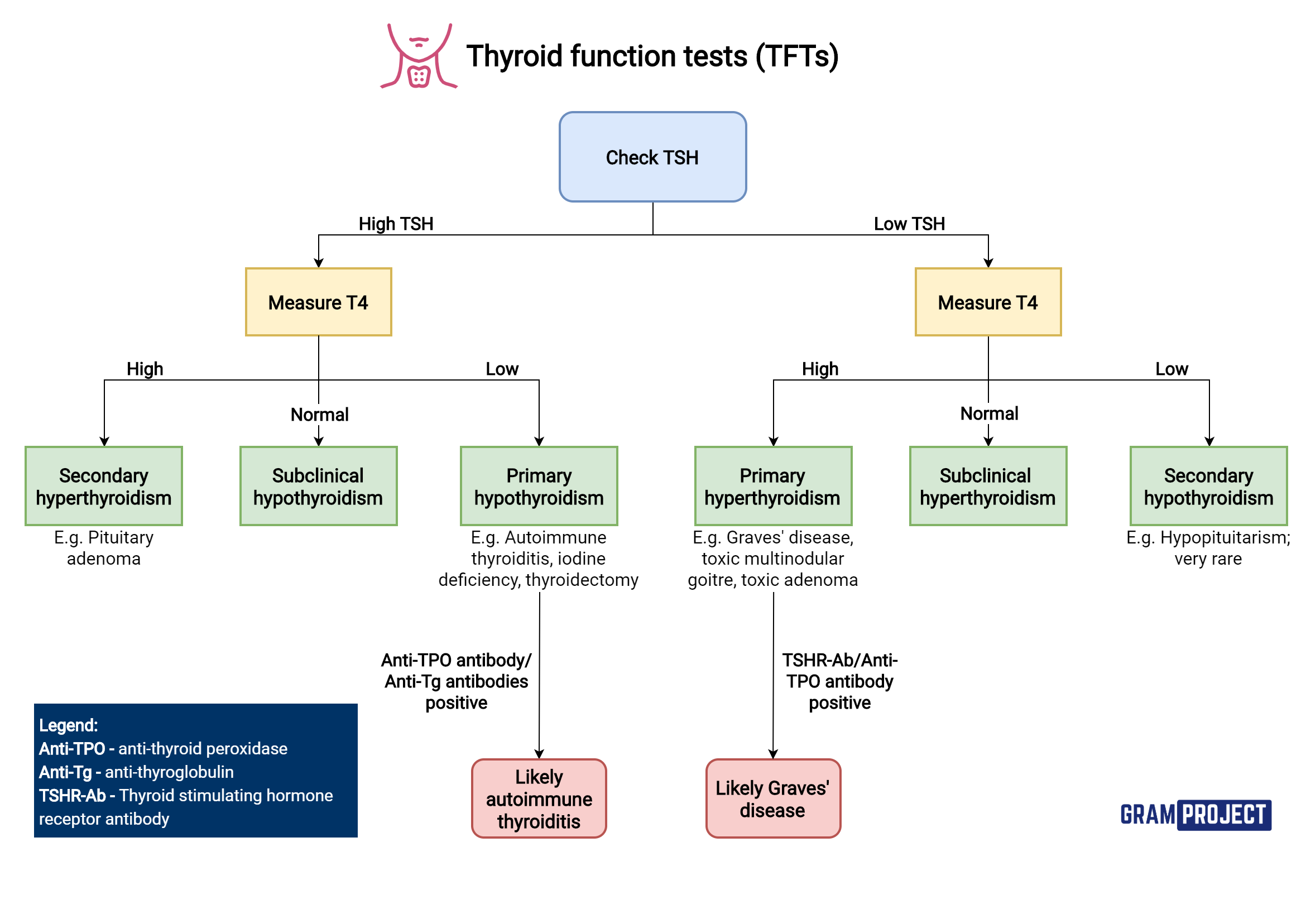
The American Thyroid Association recommends the combined use of TSH and free T4 as the most efficient combination of blood tests for diagnosis and follow-up of both ambulatory and hospitalized patients. Testing begins with TSH, because it is the most sensitive indicator of thyroid metabolism in patients with normal pituitary gland function. TSH usually shifts out of the normal range sooner than thyroxine or FT4. Linear changes in FT4 concentration result in logarithmic changes in TSH secretion. About 85% of patients have normal TSH values and do not require further testing.
Decreased TSH values suggest primary hyperthyroidism, exogenous hyperthyroxinemia, or the effect of glucocorticoids. Subsequent measurement of FT4 serves as an index of the severity of hyperthyroidism, because TSH levels can be suppressed even by small increases in FT4. If FT4 is normal, total or free T3 should be measured to detect T3 toxicosis.
|
|
TSH Low |
TSH Normal |
TSH High |
|
fT4 High |
Hyperthyroid Nonthyroid illness Acute psychiatric illness |
TSH secreting tumor Amiodorone Estrogen Thyroxine resistance TBG abnormality |
TSH secreting tumor Thyroxine resistance |
|
fT4 Normal |
Subclinical- hyperthyroid T3 toxicosis T4 over-replacement Early pregnancy Dopamine, Levodopa Glucocorticoids |
Euthyroid |
Subclinical -hypothyroid Anti-TPO Iodine drugs Contrast media Antithyroid drugs Insufficient T4 Rx
|
|
fT4 Low |
Hypopituitarism Nonthyroid illness Dopamine |
Hypopituitarism TBG abnormality Nonthyroid illness Phenytoin Carbamazepine Salicylate Androgens |
Hypothyroid Insufficient T4 Rx Anti-thyroid drugs Iodine Lithium |
Increased TSH levels suggest primary hypothyroidism. However, the rare conditions of a TSH secreting pituitary adenoma or thyroid hormone resistance may be present. If FT4 levels are low, the patient is hypothyroid. Normal FT4 levels are consistent with either a euthyroid state or subclinical hypothyroidism. These two possibilities may be distinguished by testing for thyroid peroxidase antibodies.
Patients with pituitary disease or neuropsychiatric disorders may require more extensive testing. Pituitary tumors may produce TSH, which can cause secondary hyperthyroidism. Patients with previous thyroid ablation may have decreased TSH related to secondary hypothyroidism.
The following medications may increase TSH levels: dopamine antagonists chlorpromazine, haloperidol, and iodine containing drugs. TSH may be decreased by exogenous thyroxine, glucocorticoids, dopamine, levodopa, dopamine agonists, apomorphine, and pyridoxine.
Nonthyroid illness and poor nutrition can cause many aberrations in pituitary and thyroid function. Seventeen percent of hospitalized adults have abnormal elevations or depression of TSH. In general, the more severe the illness, the more abnormal the tests. In critically ill patients, especially those receiving dopamine, TSH production is often reduced. As the illness progresses, T4 production is also reduced. A smaller group of patients with nonthyroid illness have increased serum T4 levels.
Although there is a consensus that the lower limit of the euthyroid reference range for TSH should be 0.2-0.4 mIU/L, there is still disagreement about where the upper limit should be set. For many years, endocrinologists considered TSH levels >10 mIU/L to be evidence of thyroid failure and levels between 5 and 10 mIU/L to be evidence of mild or subclinical hypothyroidism. However, the upper reference limit for TSH has steadily declined from 10 to 4.5 mIU/mL because of improvements in TSH assays and the elimination of subjects with thyroid peroxidase antibodies from the population used to determine the reference range.
The median TSH level increases with age, starting at about age 50, in a disease free population.
|
Age |
Median TSH (mIU/L) |
|
>50 |
1.60 |
|
>60 |
1.79 |
|
>70 |
1.98 |
|
>80 |
2.08 |
The median TSH level in the total population is 1.5 mIU/mL, which is considerably below the 4.5 uIU/mL upper limit of normal reported by most laboratories. More than 95% of rigorously screened euthyroid volunteers have TSH values between 0.4 and 2.5. Individuals with a TSH >2.0 have an increased odds ratio of developing hypothyroidism. Many endocrinologists believe that a TSH result above 3.0 mIU/mL is abnormal, regardless of the fT4 result.
The National Academy of Clinical Biochemistry has recommended lowering the upper limit of the TSH reference range to 4.0 mIU/L, while the American Association of Clinical Endocrinologists has set the upper limit at 3.0 mIU/L. Other experts feel the upper limit of normal should be lowered even further to 2.5 mIU/L.
The adult reference range for TSH is 0.45-4.50 mIU/L.
The adult reference range for free T4 is 0.8-1.6 ng/dL.
The adult reference range for free T3 is 2.0-4.4 pg/mL.
Serum TSH levels exhibit considerable diurnal variation, with a maximum level occurring around midnight. TSH levels decrease as much as 50% by 08:00 to 09:30 a.m. The concentration then remains relatively constant until evening, with a smaller nadir in the late afternoon. Because of this significant diurnal variation, sequential specimens should be drawn at the same time of day.
Specimen requirement for these tests is one red top gel barrier tube of blood.
References
Bethune JE. Interpretation of thyroid function tests. Dis Mon. 1989 Aug; 35(8):541-595.
Gruhn JG, Barsano CP, Kumar Y. The development of tests of thyroid function. Arch Pathol Lab Med. 1987 Jan; 111(1):84-100.
Ross DS, et al. 2016 American Thyroid Association Guidelines for Diagnosis and Management of Hyperthyroidism and Other Causes of Thyrotoxicosis. Thyroid. 2016;26(10):1343-1421.
Salvatore D, Cohen R, Kopp PA, Larsen PR. Thyroid pathophysiology and diagnostic evaluation. In: Melmed S, Auchus RJ, Golfine AB, Koenig RJ, Rosen CJ, eds. Williams Textbook of Endocrinology. 14th ed. Philadelphia, PA: Elsevier; 2020:chap 11.
American Association of Clinical Endocrinologists medical guidelines for clinical practice for the evaluation and treatment of hyperthyroidism and hypothyroidism. Endocr Pract. 2002 Nov-Dec; 8(6):457-469.
Stagnaro-Green A, et al. Guidelines of the American Thyroid Association for the diagnosis and management of thyroid disease during pregnancy and postpartum. Thyroid. 2011; 21(10):1081-1125.
Aoki Y, Belin RM, Clickner R, Jeffries R, Phillips L, Mahaffey KR. Serum TSH and total T4 in the United States population and their association with participant characteristics: National Health and Nutrition Examination Survey (NHANES 1999–2002). Thyroid 2007; 17:1211–1223.



 How to resolve AdBlock issue?