

Hashimoto's thyroiditis is the most common cause of hypothyroidism in iodine-sufficient areas of the world. The name Hashimoto's thyroiditis is derived from a 1912 pathology report by Hashimoto describing patients with goiter and intense lymphocytic infiltration of the thyroid, which he called struma lymphomatosa. Hashimoto's thyroiditis is primarily a disease of women, with a female to male ratio of approximately 7 to 1. It is characterized clinically by gradual thyroid failure, with or without goiter formation.
Hashimoto’s thyroiditis is caused by autoimmune-mediated destruction of the thyroid gland involving apoptosis of thyroid epithelial cells. Nearly all patients have high serum concentrations of autoantibodies against one or more thyroid antigens, diffuse lymphocytic infiltration of the thyroid, and follicular destruction.
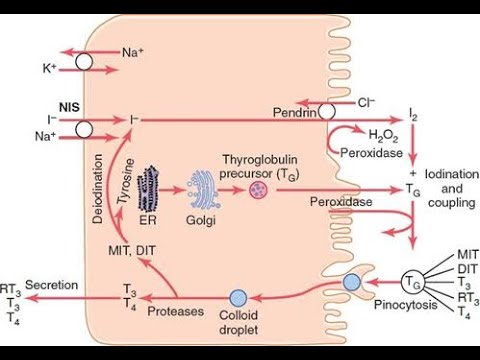
Thyroid autoantibodies are directed to thyroid peroxidase (formerly known as microsomal antigen) and thyroglobulin. TPO is an important enzyme in thyroid hormonogenesis that is located on the luminal surface of thyroid epithelial cells. TPO catalyzes both tyrosine iodination and coupling of attachment of iodotyrosyl residues to form T3 and T4.
Measurement of thyroid peroxidase (TPO) antibodies is a more sensitive test for diagnosis of thyroiditis. Measurement of TPO antibodies is especially useful in confirming a diagnosis of subclinical hypothyroidism in patients with elevated serum TSH concentration and normal free T4 concentration. Between 5 and 25% of patients with high titer TPO antibodies convert to overt hypothyroidism each year.
Anti-TPO antibodies are almost always detectable in patients with Hashimoto thyroiditis, atopic thyroiditis, and postpartum thyroiditis. Anti-TPO antibodies are also present in many cases of Grave’s disease. Antibody is seldom detectable in non-autoimmune thyroid diseases.
The improved sensitivity and specificity of current TPO antibody assays obviates the need to test for anti-thyroglobulin antibody. Caution must be exercised in interpreting positive results because 10% of adults may have low titers of thyroid antibodies and no symptoms.
The BeckmanCoulter DXI 800) thyroperoxidase (TPO) antibody assay is a sequential 2-step immunoenzymatic (sandwich) assay. A sample is added to a reaction vessel with paramagnetic particles coated with thyroid peroxidase protein. The serum or plasma TPO antibody binds to the thyroid peroxidase. After incubation in a reaction vessel, materials bound to the solid phase are held in a magnetic field while unbound materials are washed away. Protein A-alkaline phosphatase conjugate is added and binds to the TPO antibody. After the second incubation, materials bound to the solid phase are held in a magnetic field while unbound materials are washed away. The chemiluminescent substrate Lumi-Phos 530 is added to the vessel and light generated by the reaction is measured with a luminometer. The light production is directly proportional to the concentration of TPO antibody in the sample.
Reference range is <9.0 IU/mL.
Specimen requirement is red top tube of blood (serum).
References
Khoury EL, et al. Presence of the organ-specific “microsomal” autoantigen on the surface of human thyroid cells in culture: its involvement in complement-mediated cytotoxicity. Clinical and Experimental Immunology,1981;45:316–328.
Saravanan P, Dayan CM. Thyroid autoantibodies. Endocrinol Metab Clin North Am. 2001;30(2):315-337.
Frohlich E, Wahl R. Thyroid Autoimmunity: Role of Anti-thyroid Antibodies in Thyroid and Extra-Thyroidal Diseases. Front Immunol, 2017;8:521.
Gharib H, et al. Consensus Statement #1: Subclinical thyroid dysfunction: a joint statement on management from the American Association of Clinical Endocrinologists, the American Thyroid Association, and the Endocrine Society. Thyroid. 2005;15(1):24-28.
Garber JR, et al, Clinical practice guidelines for hypothyroidism in adults: cosponsored by the American Association of Clinical Endocrinologists and the American thyroid Association, Endocrin Pract, 2012;18(6):989-1028.
Constaninescu SM, et al, Significance of thyroperoxidase and thyroglobulin antibodies in medically treated Grave’s disease, European Thyroid J, 2023;12(6): https://doi.org/10.1530/ETJ-23-0193



 How to resolve AdBlock issue?