

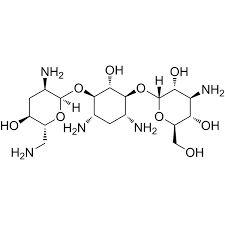
Tobramycin is an aminoglycoside antibiotic used to treat severe infections caused by aerobic Gram negative bacteria such as Citrobacter freundii, Enterobacter (all species), Escherichia coli, Klebsiella pneumoniae, Proteus mirabilis, Providencia stuartii, Pseudomonas aeruginosa, and Serratia. It is often used in combination with beta-lactam therapy.
Tobramycin can be administered intramuscularly or intravenously. Because fat stores are poorly accessible to tobramycin, dosage should be calculated based on lean body weight rather than actual body weight. Less than 10% of circulating drug is protein bound. Tobramycin is not metabolized. The kidney eliminates parent drug almost entirely. In patients with normal renal function, 60% of a dose is excreted in 6 hours and 90% within 24 hours.
Tobramycin has a narrow therapeutic to toxic ratio. Peak and trough levels should be measured beginning on the second or third day of treatment to assess dosage adequacy and to minimize the risk of ototoxicity and nephrotoxicity. Both levels should be repeated every 23 days if the patient is receiving more than 1.5 mg/kg for 10 days or more.
Nephrotoxicity is are most closely related to the length of time that trough levels exceed 2 ug/mL. Serum creatinine levels should be monitored every 2 to 3 days to assess renal function. Tobramycin has less commonly been associated with hearing loss due to ototoxicity.
Variability in renal function, extracellular fluid volume, fever, anemia, and concomitant administration of carbenicillin or Lasix significantly affects individual levels.
Trough levels should be drawn within 30 minutes of the next scheduled dose. Peak levels should be drawn 30 to 60 minutes after an IV infusion ends or 60 minutes after an IM injection.
Tobramycin is measured by a homogeneous enzyme immunoassay. Therapeutic peak range is 3 to 12 ug/mL. Peak levels greater than 12.0 ug/mL can be toxic. Therapeutic trough level is 0 to 2 ug/mL. Levels above 2.0 ug/mL can cause toxicity.
Specimen requirement is one plain red-top tube of blood.
References
Hammett-Stabler CA, Johns T: Laboratory Guidelines for Monitoring of Antimicrobial Drugs. Clin Chem 1998;44(5):1129-1140.
Krause KM, et al. Aminoglycosides: An Overview. Cold Spring Harb Perspect Med. 2016 Jun 01;6(6):a027029.
Kotra LP, Haddad J, Mobashery S. Aminoglycosides: perspectives on mechanisms of action and resistance and strategies to counter resistance. Antimicrob Agents Chemother. 2000 Dec;44(12):3249-56.



 How to resolve AdBlock issue?