

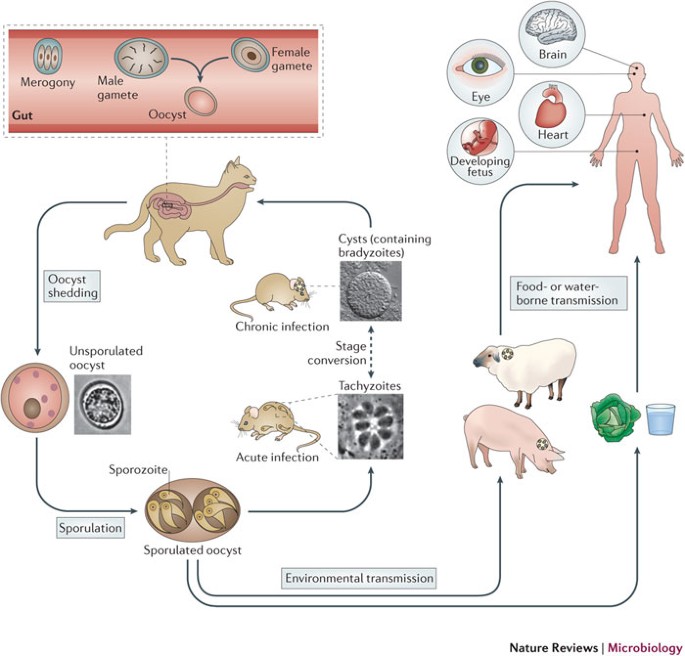
Toxoplasma gondii is a small intracellular protozoan parasite that can infect any warm-blooded animal. Three forms of the parasite are recognized. Two of these forms (the trophozoite or proliferative form and the bradyzoite or cyst form) are found in the extraintestinal cycle in all hosts, while the third form (the oocyst) is found only in cats.
Cats are the definitive hosts. Infected cats shed oocysts in feces that rapidly mature in soil and become infectious. Intermediate hosts in nature (including birds and rodents) become infected after ingesting soil, water or plant material contaminated with oocysts. Oocysts transform into tachyzoites shortly after ingestion. These tachyzoites localize in neural and muscle tissue and develop into tissue cyst bradyzoites. Cats become infected after consuming intermediate hosts harboring tissue cysts.
Humans can become infected by several routes:
- Eating undercooked meat of animals harboring tissue cysts
- Consuming food or water contaminated with cat feces
- Exposure to contaminated environmental samples such as cat litter boxes
- Blood transfusion or organ transplantation
- Vertically from mother to fetus
Following human infection, parasites form tissue cysts, primarily in skeletal muscle, myocardium, brain, and eyes. These cysts may persist throughout the life of the host.
Acquired infections in immunocompetent persons are usually asymptomatic. However, 10% to 20% of people with acute infections may develop fever and lymphadenopathy. The clinical course is usually self-limited, with symptoms resolving in a few weeks. In rare cases ocular infections with loss of vision may occur.
Severe toxoplasmosis may develop in immunosuppressed hosts, either as a result of acquiring an acute infection or by reactivation of a latent infection. The disease usually presents with, encephalitis, myocarditis, or pneumonitis.
When toxoplasma infection is acquired during pregnancy there is a significant risk of fetal infection because toxoplasmosis can be vertically transmitted through the placenta. It is generally agreed that congenital infection takes place only when an acute infection is acquired during pregnancy. Women who are infected prior to becoming pregnant rarely, if ever, have infected neonates. Seronegative women who become infected during pregnancy may give birth to an infected fetus.
Congenital toxoplasmosis occurs in 1/500 to 1/1000 of live births. Up to one-half of infants are born prematurely. The risk to the fetus appears related to the time of maternal infection. Microcephaly or hydrocephaly with intracranial calcifications may develop if infection is acquired in the first half of pregnancy. Infections in the second half of pregnancy are usually asymptomatic at birth with chorioretinitis or central nervous system manifestations developing months or years later. However, some infants may exhibit fever, hepatosplenomegaly and jaundice at the time of birth. Congenital toxoplasmosis is a significant cause of blindness, psychomotor retardation, and convulsive disorders.
The initial serologic response in immunocompetent patients with toxoplasmosis is the simultaneous rise of IgG and IgM antibodies. IgG antibodies persist for years, while IgM antibodies decline to undetectable levels within within 6 to12 months after the initial infection. Therefore, positive IgM antibodies alone, or together with IgG antibodies, are diagnostic of a recent infection. Positive IgG antibodies alone indicate previous infection.
IgM antibody may not become elevated in patients who are immunocompromised. Serologic results may be difficult to interpret in suspected intrauterine infection.
Detection of Toxoplasma gondii DNA by real-time polymerase chain reaction (RT-PCR) is a reliable alternative for the diagnosis of toxoplasmosis. DNA is extracted from clinical specimens. The B1 gene of Toxoplasma gondii is amplified and detected by real-time PCR. This is a qualitative PCR assay and results are reported as positive or negative. Reference value is negative. A positive result indicates the presence of DNA from Toxoplasma gondii. The limit of detection (LoD) is <5,000 copies/mL. A negative result does not necessarily indicate the absence of disease.
Toxoplasma gondii DNA can be detected in blood as well as ocular fluid, cerebrospinal fluid and amniotic fluids. Blood may not be as sensitive as body fluid for detecting organ specific disease. Specimen requirement is a lavender-top tube of blood, 0.5 mL of amniotic fluid, 0.3 mL of ocular fluid, or fresh tissue.
References
Robert-Gangneux F, Darde ML. Epidemiology of and diagnostic strategies for toxoplasmosis. Clin Microbiol Rev. 2012;25(2):264-296.
Maldonado YA, Read JS. Committee on infectious diseases. Diagnosis, treatment, and prevention of congenital toxoplasmosis in the United States. Pediatrics. 2017;139(2):e20163860.
Dhakal R, et al. Significance of a positive Toxoplasma immunoglobulin M test result in the United States. J Clin Microbiol 2015;53:3601–3605.



 How to resolve AdBlock issue?