

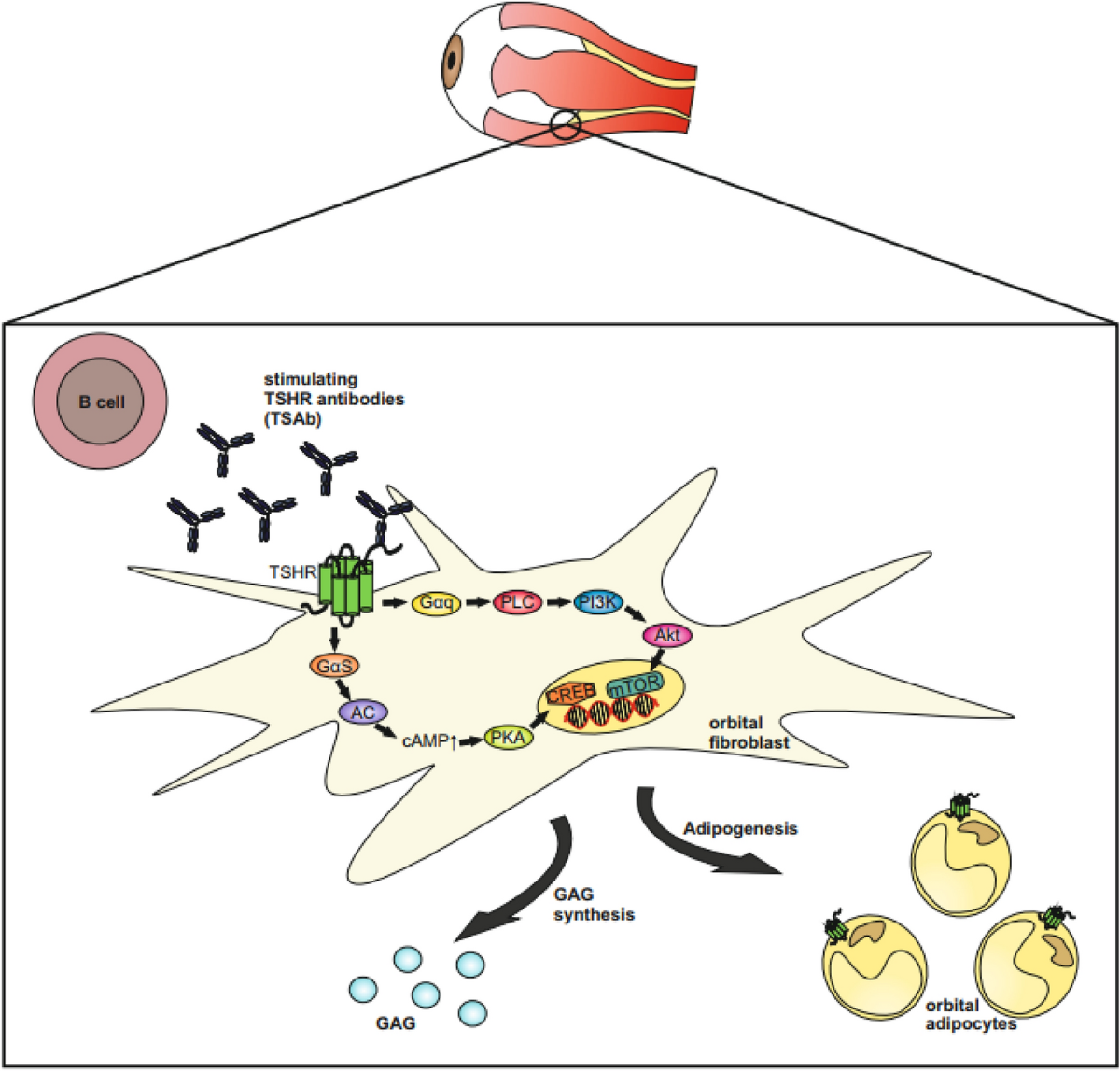
All forms of autoimmune thyrotoxicosis (Grave’s disease, Hashitoxicosis, and neonatal thyrotoxicosis) are caused by the production of TSHR-stimulating autoantibody (TSHR-antibody), which are also known as long-acting-thyroid-stimulator (LATS) or thyroid-stimulating immunoglobulins (TSI). These autoantibodies bind to the thyrotropin receptor and activate it, leading to stimulation of the thyroid gland independent of normal thyrotropin (TSH) stimulation. TSHR autoantibody may be detected before autoimmune thyrotoxicosis becomes clinically apparent.
Since none of the treatments for Graves’ disease are aimed at the underlying disease process, but rather at thyroid ablation or thyroid hormone synthesis, TSI may persist after clinical cure. This is particularly important for pregnant women with a history of Graves’ disease that were treated with thyroid-ablative therapy. Some of these women may continue to produce TSI. Since TSI are IgG antibodies, they can cross the placental barrier and cause neonatal thyrotoxicosis. Significant neonatal thyrotoxicosis is likely if a pregnant woman with a history of Graves’ disease has TSHR Ab concentrations of >3.25 IU/L during the last trimester.
TSHR-antibody is a binding assay that detects both TSI and TSHR-blocking autoantibodies. It can be used instead of this TSI assay for most applications. TSHR-antibody test has a shorter turnaround time than the TSI assay, is less expensive, and if interpreted within the clinical context, has excellent correlation with the TSI assay. A TSHR antibody cutoff point of 1.75 IU/L has a sensitivity of 97% and a specificity of 99% for detection of Graves disease.
Roche TSH/thyrotropin receptor antibody (TRAb) assay is a competitive assay using electrochemiluminescence detection. Patient specimen is treated with a reagent buffer consisting of a pre-formed immune complex of solubilized porcine thyrotropin (TSH) receptor and biotinylated anti-porcine TSH receptor mouse monoclonal antibody. TRAb in patient's serum are allowed to interact with the TSH receptor complex. After addition of streptavidin-coated microparticles and a human thyroid-stimulating monoclonal autoantibody (M22) labeled with a ruthenium complex, bound TRAb are detected by their ability to inhibit the binding of labeled M22. The entire complex becomes bound to the solid phase via interaction of biotin and streptavidin. This reaction mixture is aspirated into measuring cell where the bound microparticles are captured onto the electrode surface and unbound substances are removed. Voltage is applied to the electrode inducing a chemiluminescent emission, which is then measured against a calibration curve to determine the amount of thyrotropin receptor antibody in the patient specimen.
References
College of American Pathologists, Antibodies to the TSH Receptor, S2_A 2018.
Ross DS, et al, 2016 American Thyroid Association guidelines for diagnosis and management of hyperthyroidism and other causes of thyrotoxicosis, Thyroid,2016;26:1343-1421.
Shyamasunder AH, Abraham P, Measuring TSH receptor antibody to influence treatment choices in Graves disease, Clin Endocrinol, 2017;86:652-657.
Lee SY, Pearce EN, Hyperthyroidism: A Review, Journal Amer Med Assoc, 2023;330(15):1472-1483.



 How to resolve AdBlock issue?