

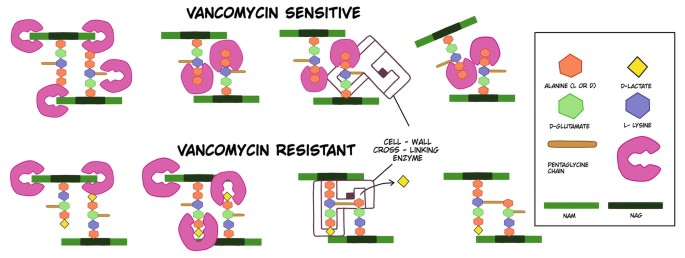
Vancomycin is a bactericidal glycopeptide antibiotic that inhibits the polymerization of peptidoglycans in the bacterial cell wall. Vancomycin binds to D-alanyl D-alanine, which inhibits glucosyltransferase (peptidoglycan synthase) and the P-phospholipid carrier, thereby preventing the synthesis and polymerization of N-acetylmuramic acid and N-acetylglucosamine within the peptidoglycan layer. This inhibition weakens bacterial cell walls and ultimately causes leakage of intracellular components, resulting in bacterial cell death.
Vancomycin is active against most Gram positive bacteria. It is particularly effective against methicillin-resistant Staphylococcus aureus, coagulase-negative staphylococci, and penicillin resistant Enterococci. Vancomycin is prescribed for serious infections such as septicemia, pneumonia, endocarditis, osteomyelitis, soft tissue infections, and meningitis. Vancomycin is also used for infections associated with indwelling devices such as prosthetic heart valves, hip replacements, cerebrospinal fluid shunts, and intravenous catheters. Oral vancomycin is used to treat Clostridium difficile infections.
Vancomycin has a plasma half-life of 3 to 9 hours in patients with normal renal function. Glomerular filtration eliminates 90% of an intravenous dose over 24 hours, without biochemical modification. Renal failure vastly prolongs the plasma half-life.
Vancomycin can cause nephrotoxicity and ototoxicity, especially in patients with impaired renal function or prolonged treatment regimens. Ototoxicity does not correlate with peak or trough levels. Nephrotoxicity may be associated with trough concentrations of 20 ug/mL or higher. Thus, many hospitals, recommend monitoring only trough levels in most patients. If trough levels are in the therapeutic range, it is very unlikely that peak levels are above 40 ug/mL.
Trough levels are recommended prior to the fourth dose and at least weekly thereafter in the following groups of patients:
- Patients receiving aminoglycosides with vancomycin
- Anephric patients receiving dialysis
- Patients receiving higher than usual doses
- Patients with changing renal function
- Patients with altered volume of distribution
- Patients with congestive heart failure
- Patients on long term therapy
- Patients not responding to therapy
Adequate trough levels, but not peak levels, correlate with efficacy. Most standard dosing regimens result in trough levels that are within the therapeutic range. Vancomycin is measured by enzyme immunoassay. Peak serum levels normally range from 25 to 40 ug/mL, while therapeutic trough levels range from 10 to 20 ug/mL.
Peak levels should be collected at 2 hours after the last dose. Peak levels drawn at shorter intervals are more variable. Trough levels should be drawn immediately preceding the next dose. Specimen requirement is one plain red top tube of blood.
References
Rybak M, et al: Therapeutic drug monitoring of vancomycin in adult patients: A consensus review of the American Society of Health-System Pharmacists, the Infectious Diseases Society of America, and the Society of Infectious Diseases Pharmacists. Am J Health Syst Pharm. 2009;66:82-98.
Monteiro JF, et al. Vancomycin therapeutic drug monitoring and population pharmacokinetic models in special patient subpopulations. Pharmacol Res Perspect. 2018;6(4):e00420.
Wilhelm MP. Vancomycin. Mayo Clin Proc. 1991;66(11):1165-70.



 How to resolve AdBlock issue?