

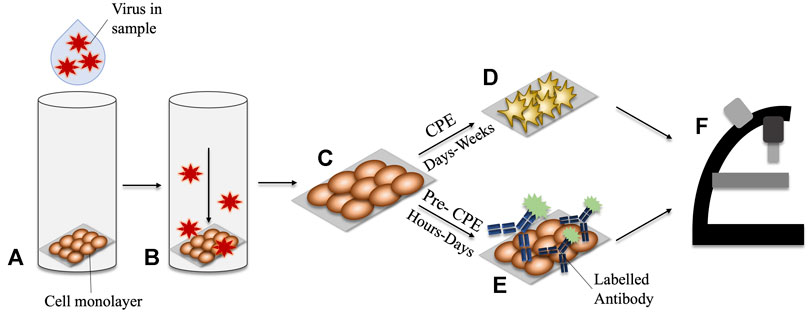
Living cells are required to grow viruses in the laboratory. A combination of tube media and shell vials containing specialized cell lines are classically used for virus cultures. Viruses can be detected their cytopathic effect or by antibody staining.
The most common specimens received for viral culture include body fluid, rectal, spinal fluid, and feces. Viral culture can detect adenovirus, cytomegalovirus, enteroviruses, herpes simplex virus (HSV) types 1 and 2, and varicella zoster virus (VZV).
Many common viruses cannot be recovered in viral culture. A negative viral culture result does not preclude viral infection. Examples of viruses that are not routinely recovered in culture include: Coxsackie A virus, hepatitis viruses, arboviruses, parvoviruses, human papillomaviruses and gastrointestinal viruses (rotavirus, coronavirus, calicivirus, astrovirus, sapovirus and norovirus.
For decades, virus cultures were considered the gold standard for virus detection despite their long turnaround times and lack of sensitivity. Polymerase chain reaction (PCR) has become the gold standard for detection of many viruses because of its faster turnaround time, higher sensitivity, and ability to detect viruses that do not grow in culture.
PCR is recommended for diagnosing:
- Adenovirus in tissue specimens
- Cytomegalovirus, Enterovirus, Epstein-Barr virus, Herpes Simplex virus 1 & 2, and Varicella-Zoster virus in CSF
- Mumps virus from buccal swabs
- Measles (Rubeola) virus from nasopharyngeal swabs or urine
Human Papillomavirus can be detected by hybrid capture from a cervical brushing.
A Gastrointestinal Pathogen Panel can detect adenovirus 40/41, Astrovirus, Norovirus, Rotavirus A, and Sapovirus.
A Respiratory Pathogen Panel can detect adenovirus, coronavirus, human metapneumovirus (hMPV), influenza A & B viruses, parainfluenza virus (1,2,3,4), respiratory syncytial virus, and rhinovirus/enterovirus.
Specimens for viral culture include are eye swab, rectal swab, genital swab, throat swab, cerebrospinal fluid, stool, tissue, and urine. Specimens should be collected during the acute phase of the disease. Swabs should be rinsed immediately into viral transport medium.
References
Hematian A, et al, Traditional and Modern Cell Culture in Virus Diagnosis, Oson Pub Health Res Perspect, 2016;7(2):77-82.
Cassedy A, Parle-McDermott, O’Kennedy R, Virus Detection: A Review of Current and Emerging Molecular and Immunological Methods, Front Mol Biosci, 2021;8:



 How to resolve AdBlock issue?