

Rickettsia are small intracellular bacteria. Rickettsial infections in the United States are caused by 2 major groups within the genus Rickettsia: spotted fever group and typhus fever group. The spotted fever group includes Rickettsia rickettsii (Rocky Mountain spotted fever), Rickettsia akari, Rickettsia conorii (Boutonneuse fever), Rickettsia australis (Queensland tick typhus), and Rickettsia sibirica (North Asian tick typhus). The typhus fever group includes Rickettsia typhi (murine typhus; endemic typhus) and Rickettsia prowazekii (epidemic typhus).
R. rickettsiae is the most common rickettsial species encountered in the United States and is transmitted through by a tick (Dermacentor species or Rhipicephalus sanguineus). Following a 2 to 14-day incubation period, patients commonly present with fever, chills, and myalgia. Approximately 90% of patients develop a maculopapular rash 2 to 5 days after fever onset.
The Weil-Felix reaction was first described in 1916 as a test to diagnose rickettsial infections. The test was based on the observation that some Proteus bacteria had antigenic crossreactivity with Rickettsia. Proteus antigens were purified to develop a heterophile agglutination test to identify antibodies against Rickettsiae disease groups. Proteus vulgaris OX-19 antigen reacts with antibodies to the typhus group, P. mirabilis OX-K antigen reacts with antibodies to the scrub typhus group, and both P. vulgaris OX-2 and OX-19 antigens react with antibodies to the spotted fever group.
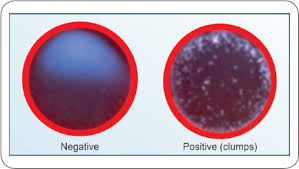
The test is performed by mixing patient’s serum with a suspension of proteus antigen on a white tile. The tile is then rotated for one minute. If antibody against rickettsiae is present, agglutination occurs. If the test result is positive, serial dilutions of patient’s serum are tested to determine antibody titer.
Agglutination patterns can be interpreted as follows:
|
Infection |
OX-19 |
OX-2 |
OX-K |
|
Epidemic typhus |
+ |
- |
- |
|
Murine typhus |
+ |
- |
- |
|
Spotted fever group |
+ |
- |
- |
|
Spotted fever group |
- |
+ |
- |
|
Scrub typhus |
- |
- |
+ |
|
Q fever |
- |
- |
- |
The concentration of IgM antibody necessary to produce a positive result is usually not obtained until 5 to 10 days after the onset of illness. False positive results occur. Agglutination with OX-19 antigens, with titers as high as 1:160, have been reported in individuals not infected with rickettsiae.
Due to its low sensitivity and specificity, the Weil-Felix test is no longer recommended. The current gold standard in diagnosing rickettsial infections is an indirect immunofluorescence assay. Detection of Rickettsia species DNA by real-time polymerase chain reaction (RT-PCR) is also available.
References
Kovácová E, Kazár J. Rickettsial diseases and their serological diagnosis. Clin Lab. 2000;46(5-6):239-245.
Mahajan SK, et al, Relevance of Weil-Felix test in diagnosis of scrub typhus in India. J Assoc Physicians India. 2006;54:619-21.
Hechemy KE, et al, Discrepancies in Weil-Felix and microimmunofluorescence test results for Rocky Mountain spotted fever. J Clin Microbiol. 1979;9(2):292-293.



 How to resolve AdBlock issue?