

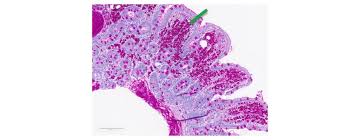
Whipple’s disease is caused by infection with Tropheryma whipplei, which is a gram positive bacterium. It is an ubiquitous environmental organism and has been identified in fecal samples in up to 20% of asymptomatic persons. However, clinical manifestations of infection occur in only 1 person per million each year. Infection most commonly occurs in males of European ancestry.
Infection commonly affects the duodenum causing weight loss, diarrhea, abdominal pain, arthralgia, and lymphadenopathy. Many of these features develop over a period of 6 to 8 years before diagnosis. Protein-losing enteropathy and poor nutrition can cause peripheral edema. Approximately one-third of patients develop pericarditis and/or endocarditis. Some patients have central nervous system involvement. They have signs of ataxia or clonus. Physical exam detects peripheral lymphadenopathy in about 50% of cases, hyperpigmentation around the malar and orbital areas, hyperkeratosis, purpura, glossitis, cheilitis, and gingivitis. Common laboratory findings include hypoalbuminemia, anemia, prolong prothrombin time, and steatorrhea.
Whipple disease is a progressively debilitating disease if left untreated. Prolonged antibiotic regimens with blood–brain barrier penetration cure most patients. Standard therapy is a 14-day course of ceftriaxone followed by a 1-year course of trimethoprim–sulfamethoxazole.
The diagnosis of Whipple’s disease is often delayed because of its rarity and many nonspecific symptoms and signs. Diagnostic tests for Whipple’s disease include histologic examination of tissue biopsies for periodic acid–Schiff (PAS)-positive granules within macrophages. Confirmation can be obtained with immunohistochemical staining of macrophages with T. whipplei–specific antibody.
A PCR assay for Tropheryma whipplei DNA can be performed on whole blood. Diagnosis of Whipple’s disease requires at least two of these three tests to be positive.
Specimen requirement for PCR is a lavender top tube of blood.
References
Dolmans RA, et al. Clinical Manifestations, Treatment, and Diagnosis of Tropheryma whipplei Infections. Clin Microbiol Rev. 2017;30(2):529-555.
Hujoel IA, et al. Tropheryma whipplei Infection (Whipple Disease) in the USA. Dig Dis Sci. 2019;64(1):213-223.
Sloan LM, Rosenblatt JE, Cockerill FR III: Detection of Tropheryma whipplei DNA in clinical specimens by LightCycler real-time PCR. J Clin Microobiol 2005;43:3516-3518.
Frickmann H, et al. Detection of Tropheryma whipplei in stool samples by one commercial and two in-house real-time PCR assays. Trop Med Int Health. 2019;24(1):101-108.



 How to resolve AdBlock issue?