

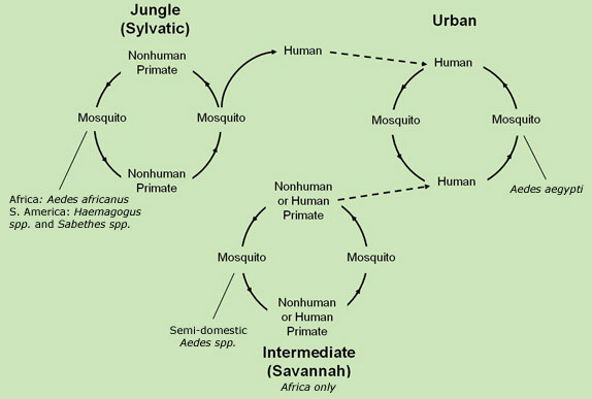
Yellow fever virus is a mosquito-borne flavivirus (arbovirus) that causes yellow fever. It has caused sporadic, deadly outbreaks in the tropics of South America, Central America, and sub-Saharan Africa for hundreds of years.
Prior to the 1600s, yellow fever and its mosquito vectors were endemic to Africa. Later, they spread to the Americas via the transatlantic slave trade. Yellow fever eventually reached Europe and became known as the "American plague”.
The development of a highly effective yellow fever vaccine in the 1930s and and the eradication of mosquitoes almost completely eradicated yellow fever virus in the Western Hemisphere and stopped urban spread in the Americas.
In the decades since, Africa has continued to experience intermittent epidemics in urban centers and yellow fever mosquitoes have re-infested much of the tropics in Central and South America. There has been a resurgence of yellow fever outbreaks in Africa and the Americas, possibly because of insufficient vaccination, inadequate mosquito control, expansion of human populations, and lack of travel restrictions.
Yellow fever infections are referred to as sylvatic or jungle cases because the typical transmission cycle occurs between forest mosquitoes and forest dwelling nonhuman primates. Humans serve as incidental hosts. So far, there has been no evidence of human-to-human transmission of yellow fever by Aedes aegypti mosquitoes.
Clinical illness manifests itself in three stages: infection, remission, and intoxication. During the infection stage, patients present after a 3 to 6-day incubation period with a nonspecific flulike illness. Symptoms may include fever, headache, malaise, nausea, vomiting, diarrhea, rash, myalgia, and arthralgia. High fevers associated with bradycardia, leukopenia, thrombocytopenia and elevated hepatic transaminases may provide a clue to the diagnosis. Patients are viremic during this stage.
The infection stage is followed by a period of remission, when most patients fully recover. However, 15 to 20% of patients then progress to the intoxication stage, in which symptoms recur. This stage is characterized by high fever, hemorrhage, liver failure with jaundice, renal failure, encephalopathy and shock. Among the patients who develop severe illness, the case fatality rate has ranged between 20% and 60%. Yellow fever virus antibodies may be detected during this stage, but viremia has usually cleared.
Diagnostic tests include real time PCR and serologic tests for yellow fever virus. PCR can detect viral RNA in plasma during the first week after the onset of symptoms. Because viremia is transient, a negative RT-PCR result does not rule-out the diagnosis of yellow fever.
Testing for IgM antibodies against the yellow fever virus is preferred to diagnose yellow fever after the first week of illness. A yellow fever vaccination history should be obtained prior to testing because IgM antibodies can persist for several years following vaccination. Serologic tests cannot distinguish between IgM antibodies produced in response to vaccine versus infection.
Serologic cross-reactions occur with other flaviviruses including West Nile and dengue viruses. Positive results should be confirmed with a more specific test such as a plaque-reduction neutralization test.
References
Hamer DH, Angelo K, Caumes E, et al. Fatal Yellow Fever in Travelers to Brazil, 2018. MMWR Morb Mortal Wkly Rep. ePub: 16 March 2018. DOI: http://dx.doi.org/10.15585/mmwr.mm6711e1
Paules CI and Fauci AS. Yellow fever – Once again on the radar screen in the Americas. New Engl J Med. 2017;376:1397-98.
Gubler, DJ, et al. Yellow Jack: a modern threat to Asia-Pacific countries? npj Viruses 3, 34 (2025). https://doi.org/10.1038/s44298-024-00079-5.



 How to resolve AdBlock issue?