

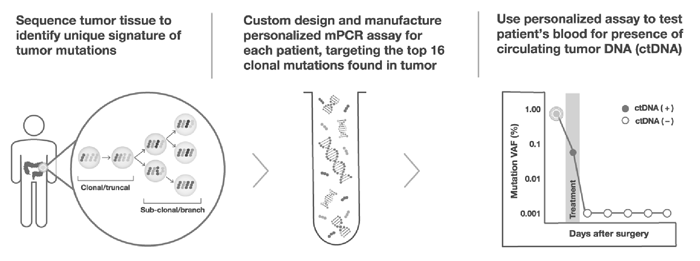
Natera has developed a test called Signatera for the detection of minimal residual disease (MRD). After a tumor is excised, Natera performs whole exome or whole genome sequencing of the tumor and a sample of the patient’s normal tissue to identify the tumor’s unique genetic signature. It then builds a personalized blood test to detect circulating tumor DNA (ctDNA) in a patient’s future blood draws.
Chemotherapy is believed to be more effective at eradicating minimal disease than it is macroscopic disease detected by imaging. Widespread adoption of Signatera requires clinical trials to demonstrate that acting on a blood-test result actually extends survival. Those results are necessary for the National Comprehensive Cancer Network (NCCN) recommend MRD testing. NCCN guidelines often determine which tests insurers will cover. Medicare already pays for MRD testing, but commercial insurers pay only about 25% of the time.
Natera has submitted a Food and Drug Administration application for Signatera in bladder cancer, backed by a late-stage trial showing improved survival for patients who tested positive.
Reference
Nakamura Y, et al, ctDNA-based molecular residual disease and survival in resectable colorectal cancer, Nature Medicine, 2024; https://doi.org/10.1038/s41591-024-03254-6



 How to resolve AdBlock issue?