

An automated complete blood count (CBC) with differential white blood cell count can determine 32 different hematological parameters. Automated cell counters incorporate a method for flagging white blood cell (WBC), red blood cell (RBC) and platelet abnormalities. The flagged abnormalities prompt a medical scientist to perform a manual peripheral smear review and differential to verify the abnormality flagged as well as allow identification of additional morphological abnormalities.
The initial microscopic evaluation of all flagged specimens is performed by a clinical laboratory scientist. Their review serves several important functions including verification of automated results; identification of abnormal, immature and atypical cells; and recognition of clinically significant morphological abnormalities. Blood smear abnormalities identified on new patients or infrequent outpatient visitors are then submitted to a clinical pathologist for confirmation and further evaluation. Any comments and findings identified by the clinical pathologist are reported as free text within the finalized report.
In rare circumstances, a peripheral blood specimen may not generate any abnormal flags by the instrument. These mostly include qualitative abnormalities such as hematological malignancies (e.g. chronic and acute leukemias, myelo-proliferative neoplasm, and myelodysplasia), hereditary hemolytic disorders (hereditary spherocytosis), and presence of infectious agents (malaria and ehrlichia). A separate request for peripheral blood smear review by a clinical pathologist should be restricted to these disorders, if clinical suspicion is high.
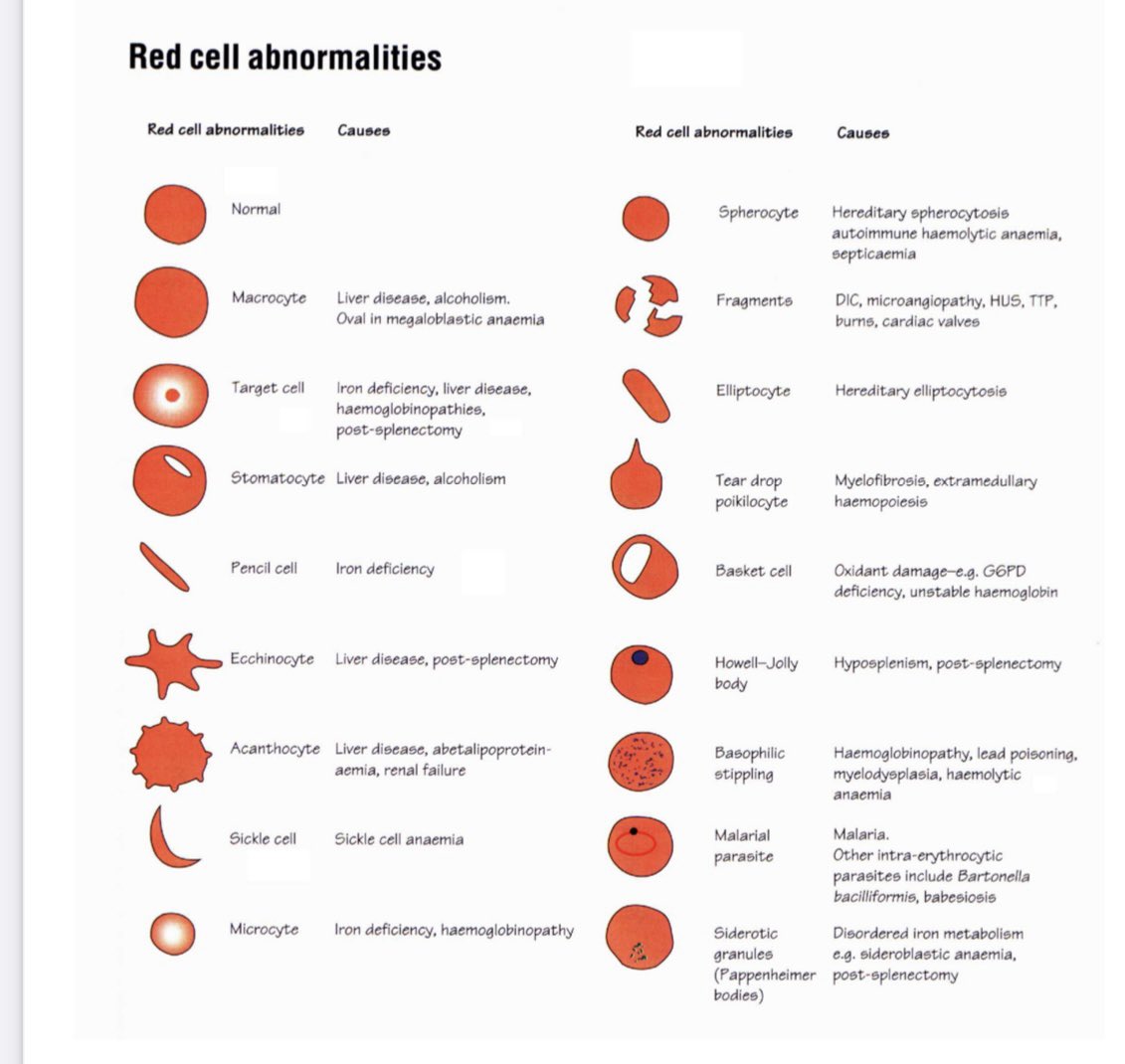
The following abnormal red blood cell abnormalities may be observed:
- Elliptocytes & ovalocytes - hereditary elliptocytosis, iron deficiency, RBC enzymopathies
- Pencil cells – iron deficiency
- Microcytes – iron deficiency, thalassemia
- Oval macrocytes - megaloblastic anemia & dyserythropoiesis
- Round macrocytes - liver disease
- Spherocytes - hereditary spherocytosis, WAIHA and DHTR
- Echinocytes (burr cells) have evenly spaced projections- storage artifact, uremia, HUS, severe burns, CABG, RBC enzymopathies
- Acanthocytes (spur cells) have irregular spaced spikes - abetalipoproteinemia, malnutrition, end stage liver disease, splenectomy, Vitamin E deficiency, McLeod syndrome
- Stomatocytes - alcohol abuse & liver disease, hydroxyurea Rx, hereditary stomatocytosis
- Target cells (codocytes) – liver disease, Hgb C, D & O, beta thalassemia, splenectomy
- Teardrop cells (Dacrocyte) - megaloblastic anemia, myelofibrosis, myelodysplasia
- Bite cells (Blister cells) - G6PD deficiency and dapsone Rx, unstable hemoglobins
- Helmet cells – TMA, mechanical valves, pulmonary emboli
- Schistocytes (fragments) - TMA, DIC, prosthetic heart valve
- Keratocyte - DIC, burns, vascular prosthesis
- Sickle cells (Drepanocytes) – Sickle cell disease, sickle cell beta thalassemia
- Rouleaux – myeloma, chronic liver disease, chronic inflammation
Target cells are thin red blood cells that have an overabundance of cell membrane, which causes the cells to assume a bell shape while in circulation. When the cells are flattened out on a smear, the top of the bell is pushed to the center creating a central target or “bulls-eye.” Target cells are most commonly seen in the following clinical conditions:
- Liver disease
- Hemoglobinopathies - Hemoglobin C, D, E
- Thalassemia
- Asplenia or Post-splenectomy
- Lecithin-cholesterol acyl transferase (LCAT) deficiency
- Artifact when blood smears are dried too rapidly
References
ASH Image Bank, https://imagebank.hematology.org/image/62464/target-cells
Aird W, Target Cells, The Blood Project, August 23, 20021, thebloodproject.com



 How to resolve AdBlock issue?