

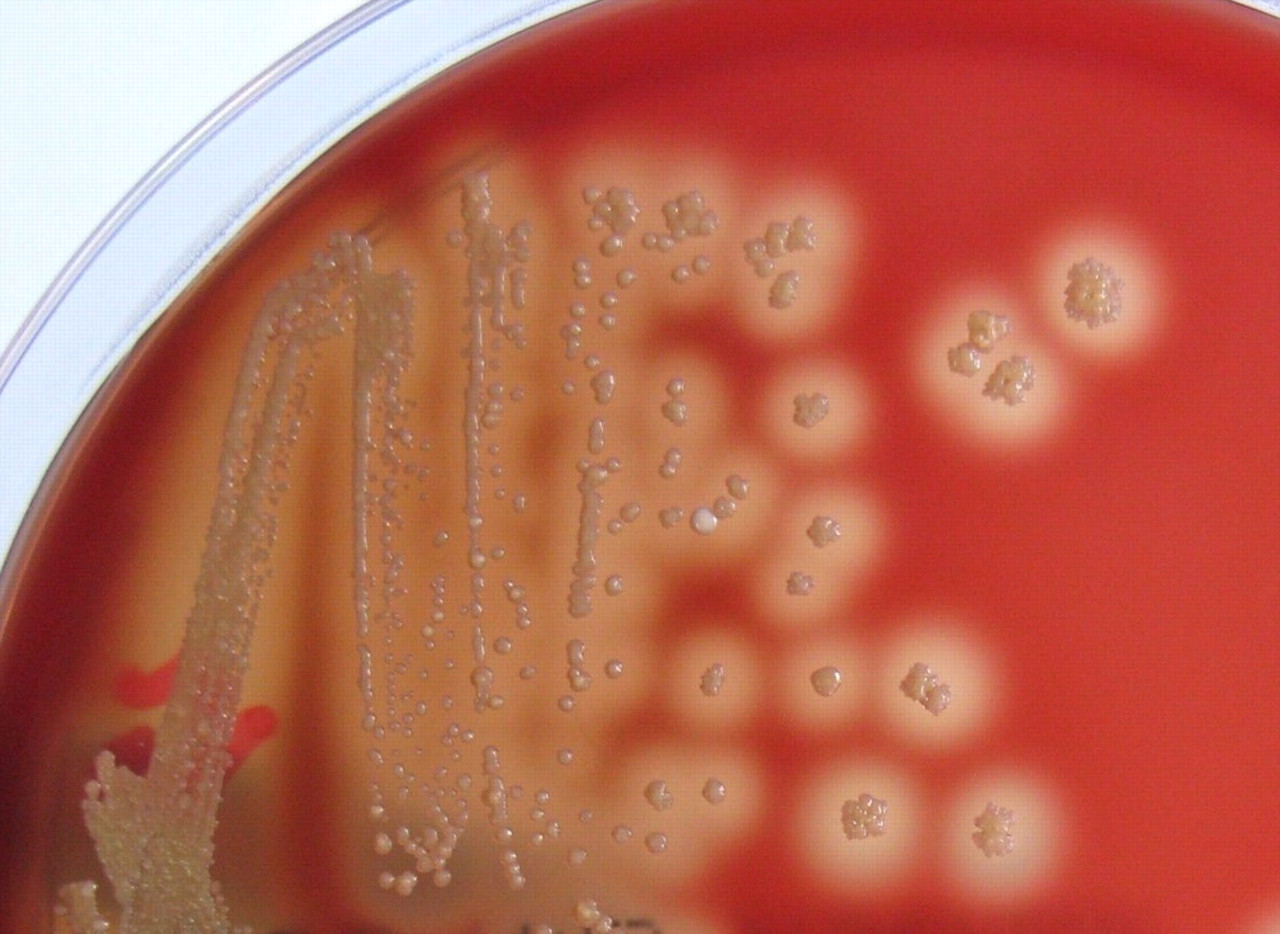
Dermatophilosis is a bacterial skin disease in animals caused by Dermatophilus congolensis. It occurs worldwide, but is most common in tropical and subtropical regions. Domestic animals commonly affected include cattle, sheep, goats, and horses. Wild animals affected include deer, rabbits, rodents, woodchucks, striped skunks, raccoons, foxes and a captive polar bear. Dermatophilus congolensis thrives in wet, humid conditions and is referred to as rain rot, rain scald, or strawberry foot rot.
The bacterium can be transmitted to animals by direct contact and by arthropods, such as ticks and biting flies. The most likely sites of infection include wet skin, cuts, and abrasions. As the bacteria invade the skin, it becomes inflamed, causing epithelial cells to proliferate. Crusts of exudate and shedded skin cells accumulate and trap hair. When crusts drop off, the underlying skin is red, inflamed, and often bleeding.
Dermatophilosis can be transmitted to people through direct contact with an infected animal. But in France and Spain, researchers have diagnosed the condition in a number of men who have sex with other men and had no known exposure to affected animals. On June 17, 2026, the European Centre for Disease Prevention and Control reported that 4 European Union countries ( France, Germany, Spain, and Sweden) had reported 70 cases of skin infections caused by D. Congolensis between December 2025 and June 2026. These cases predominantly occurred among gay, bisexual, and other men who who visited sex-in premises, such as adult spas, and had consensual sex with other men.
The clinical spectrum in these cohorts included papular, pustular or scaly, pruritic skin lesions, mainly in the genital and facial area, without systemic symptoms. All cases responded well to oral or topical antibiotics, with occasional self-limiting resolution.
Cases had also been reported in Norway among individuals practicing martial arts in 2025 and 2026. These cases indicated a possible shift in human-to-human transmission by close physical contact or by contact with contaminated surfaces.
Diagnosis of Dermatophilosis can made by microscopic examination of stained skin crusts and identification of the classic morphology of rows of Gram-positive bacteria in hypha-like arrangements. Definitive diagnosis can be made by culturing the bacteria from skin lesions on Columbia 5% sheep blood agar. Dermatophilus congolensis produces small yellowish-beta-hemolytic colonies. Gram stain reveals gram-positive coccoid forms occasionally arranged in irregular filaments with transverse septa. Definitive diagnosis can ben made using matrix-assisted laser desorption/ionization time-of-flight mass spectrometry.
References
Habte D, Addis H, Wondimagegnehu K. Clinical and Laboratory Diagnosis of Dermatophilosis (Cutaneous Streptothricosis) in Cattle in Ethiopia: Case Report. Vet Med Sci. 2025 Mar;11(2):e70245. doi: 10.1002/vms3.70245.
Descalzo V, et al. Suspected Sexual Transmission of Dermatophilosis among Men Who Have Sex with Men, Barcelona, Spain, 2025–2026, Emerg Infect Dis. 2026 Jun. https://doi.org/10.3201/eid3206.260476
European Centre for Disease Prevention and Control, Rapid risk assessment - Clusters of dermatophilosis in five EU/EEA countries in 2025-2026, June 17, 2026, Stockholm, 2026.



 How to resolve AdBlock issue?