

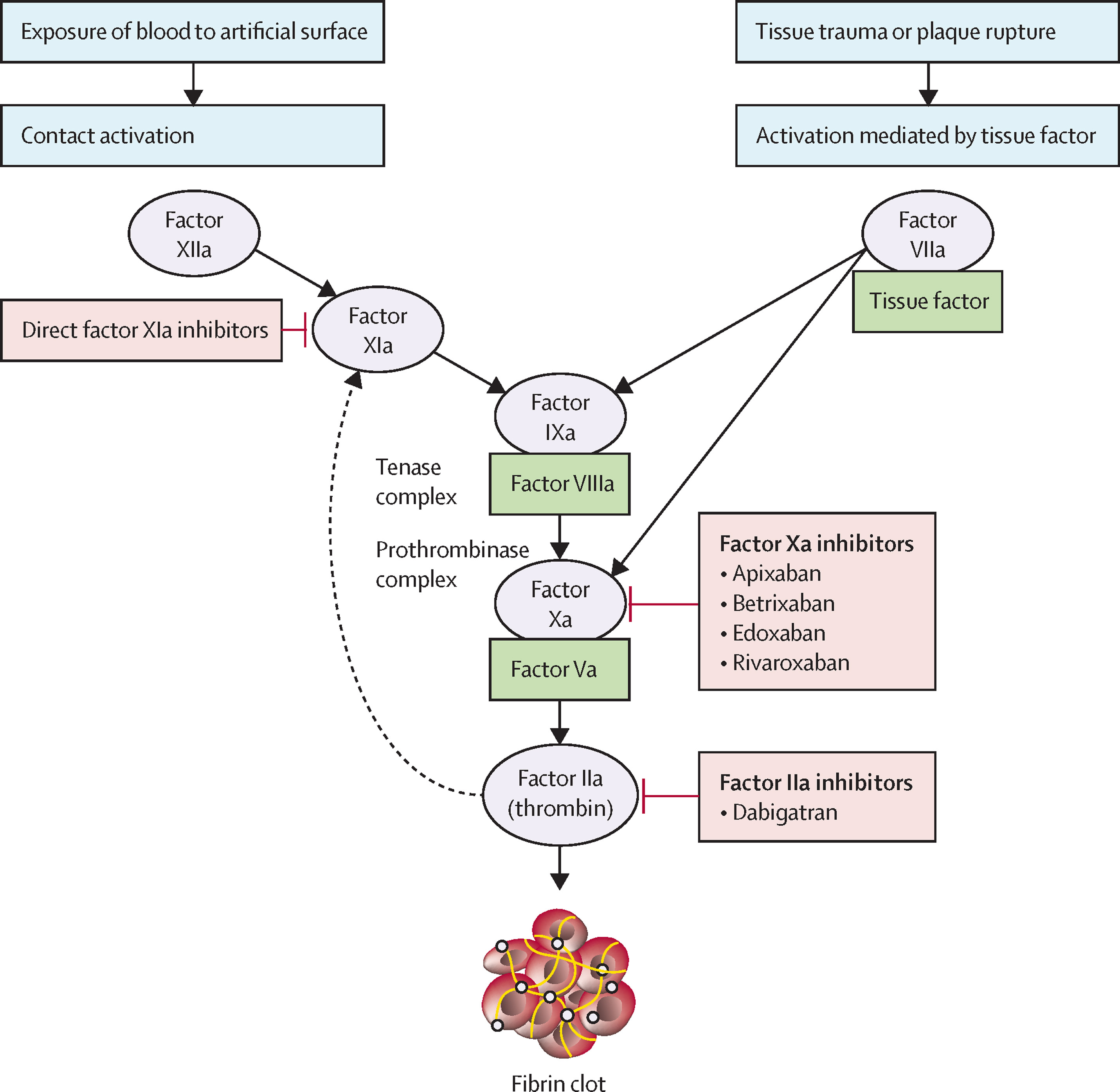
Direct oral anticoagulants (rivaroxaban, apixaban and dabigatran, edoxaban) have been approved by FDA for reducing the risk of stroke in patients with nonvalvular atrial fibrillation, and treatment of primary and recurrent venous thrombosis. Rivaroxaban has also been approved for patients with coronary artery disease and peripheral arterial disease.
The common mechanism of these new drugs is reversible blockage of the active enzyme site of thrombin (Factor IIa) or Factor Xa. Unlike warfarin, the anticoagulant effect of these new oral anticoagulants is not dependent on decreased synthesis of coagulation factors. Unlike heparin, their anticoagulant effect is not dependent on accelerating the effect of antithrombin.
These drugs have many advantages compared with warfarin including rapid onset of anticoagulation, lack of dietary restrictions, fewer drug to drug interactions, and more predictable pharmacokinetics. Like all drugs, they also have some disadvantages including dosing dependent on renal function; lack of a rapid reversal agent; and the unavailability of FDA approved companion diagnostic tests to measure their concentration or anticoagulant effect. Another problem is that these drugs interfere with routine coagulation tests in an unpredictable fashion.
All of the direct oral anticoagulants (DOAC) are given at fixed doses and do not require routine coagulation monitoring because of their predictable pharmacokinetics. Measurement of the anticoagulant effect of one of these drugs in an asymptomatic, stable patient on long term therapy could actually be harmful if a slightly elevated result prompted the clinician to deviate from the approved dose. The clinical significance of slightly elevated coagulation results with these new oral anticoagulant drugs is unknown.
Unlike warfarin, which has a long-lasting effect and can be monitored with an INR drawn at any time, NOAC are reversible and have short half lives. Knowing the timing of the last dose is critical for interpretation of results. For example, Rivaroxaban will significantly elevate the prothrombin time 4 hours after the last dose, but not at 12 hours. The potential to misinterpret a single measurement is worrisome. Also, because of their rapid onset and short half lives, it may be difficult to assess patient compliance if a patient has skipped several doses and resumed treatment the day before testing. Therefore, ordering of coagulation tests for patients receiving DOAC should be reserved for clinical situations such as life threatening bleeding, before invasive procedures or suspected overdose or noncompliance.
Effect of DOACs on Coagulation Tests
The impact of DOACs on coagulation tests varies by the methodology used for the test. In general, polymerase chain reaction, immunoassays, and platelet function tests are are not affected by DOACs.
The use of clot-based coagulation tests and some chromogenic assays should be avoided in patients taking a DOAC. Misleading results can occur with dabigatran-containing samples as they often display results suggestive of a nonspecific inhibitor effect.
Increasing concentrations of rivaroxaban and apixaban can also lead to factitiously underestimated one-stage factor activities. Rivaroxaban generally has more of an effect than apixaban, which reflects the varying sensitivities of PT and aPTT reagents to these different FXa inhibitors. As with dabigatran, apixaban and rivaroxaban often factitiously suggest the presence a nonspecific inhibitor.
Thrombin time is unaffected by FXa inhibitors but is too sensitive to dabigatran to give any indication of drug concentration. However, a dilute thrombin time can be used to quantitate dabigatran.
Specialized coagulation assays that are based on clot formation may also be affected by DOAC. Protein C activity via clot-based assay is overestimated in the presence of rivaroxaban, edoxaban, or dabigatran but not apixaban. False elevation in protein C activity could mask true deficiency of this natural anticoagulant, delaying appropriate diagnosis and management. It is recommended that chromogenic protein C activity testing be used in the presence of DOACs.
Functional testing for protein S activity can be performed via PT-, aPTT-, or Russell viper venom time (RVVT)-based clotting tests. aPTT- and RVVT-based protein S activity assays are exquisitely sensitive to dabigatran. Clot-based protein S activity may also be overestimated by FXa inhibitors and is particularly sensitive to rivaroxaban. False elevation in protein S activity could mask true deficiency of this natural anticoagulant, delaying appropriate diagnosis and management. It is recommended that immunoassay-based free protein S antigen testing be used in the presence of DOACs.
Activated protein C resistance (APCR) assays rely on clot formation with aPTT-, RVVT-, or prothrombinase-based reagents. Patient plasma is pre-diluted in factor V-deficient plasma and analyzed with and without the addition of activated protein C. A ratio between these 2 clotting times is calculated. Increasing APCR ratios have been observed with increasing concentrations of dabigatran, apixaban, rivaroxaban, and edoxaban. This interference could lead to a false normal APCR ratio in an individual who carries the factor V Leiden mutation It is recommended that molecular testing be used to test for the factor V Leiden mutation in the presence of DOACs.
Reptilase time measures fibrin formation following fibrinogen cleavage and fibrinopeptide A release by the batroxobin snake venom. The reptilase test is not affected by any of the DOACs.
DOACs often produce false positive results for lupus anticoagulant testing with clot-based assays.
The effects of DOACs on clot-based assays are summarized in the following table.
|
Test |
FXa inhibitor Interference |
FIIa Inhibitor Interference |
|
PT & aPTT |
Yes |
Yes |
|
Thrombin Time |
No |
Yes |
|
Fibrinogen activity |
No |
No |
|
Factor activities |
Yes |
Yes |
|
APCR |
Yes |
Yes |
|
Protein S |
Yes |
Yes |
|
Protein C |
Yes |
Yes |
|
Dilute Thrombin Time |
No |
Yes |
|
Reptilase Time |
No |
No |
|
Lupus Anticoagulant |
Yes |
Yes |
Relative to clot-based assays, chromogenic assays are less sensitive to interferences from DOACs. Chromogenic assays comprise 2 stages that are both independent of clot formation: activation of a serine protease capable of cleaving a specific peptide nitroanilide substrate and cleavage of the substrate to release a chromophore whose concentration is measured spectrophotometrically. Active forms of protein C, factor II, and factor X are commonly used in chromogenic reactions.
Chromogenic protein C activity assays can be reliably performed in patients taking any DOAC, since protein C is not the target of these anticoagulants and is activated directly via viper venom.
Chromogenic antithrombin assays based on factor IIa are falsely elevated in patients taking dabigatran, but are not affected by FXa inhibitors. Chromogenic antithrombin assays based on factor Xa are not interfered with dabigatran, but are unreliable in patients taking FXa inhibitors.
Chromogenic anti-Xa assays are commonly used for therapeutic monitoring of unfractionated and low molecular weight heparin. Results are falsely elevated in patients taking FXa inhibitors.
Chromogenic assays are also used to measure factor VIII, IX, and X activities. These assay rely on factor Xa activity for chromophore generation. FXa inhibitors such as apixaban and rivaroxaban may produce factitiously low factor VII, IX, and X activities.
Chromogenic assays for factor XIII yields falsely low levels in patients taking dabigatran.
The effects of DOACs on chromogenic assays are summarized in the following table.
|
Test |
FXa inhibitor Interference |
FIIa Inhibitor Interference |
|
Antithrombin (FXa-based) |
Yes |
No |
|
Antithrombin (FIIa-based) |
No |
Yes |
|
Protein C |
No |
No |
|
Factor VIII |
Yes |
No |
|
Factor X |
Yes |
No |
|
Anti-Xa Activity |
Yes |
No |
|
Factor IX |
Yes |
No |
|
Factor XIII |
No |
Yes |
|
Reptilase Time |
No |
No |
|
Lupus Anticoagulant |
Yes |
Yes |
The activated clotting time is a POC whole blood assay used to monitor heparin anticoagulation in cardiopulmonary bypass, percutaneous coronary intervention, and extracorporeal membrane oxygenation. The blood specimen is mixed with kaolin or silica, which activates the intrinsic pathway of coagulation. Clotting is detected by the movement of a magnet or photo-optically in a cartridge by the change in velocity of blood as the viscosity increases. Only dabigatran significantly prolongs the activated clotting time. The direct FXa inhibitors do not have a significant effect on the activated clotting. Therefore, heparin monitoring by activated clotting time can be performed in the presence of FXa inhibitor.
The use of viscoelastic testing (TEG or Rotem) to measure DOAC effects is not recommended. The rationale for this is a lack of specificity of alterations to the coagulation cascade. Another consideration is the relatively wide reference range of the viscoelastic methods. The major effect of the DOACs is a prolongation of the initial clotting reaction time, which reflects the coagulation cascade and the generation of thrombin. The R time may remain within the reference range even though a patient is taking a FXa inhibitor. Apixiban has the least effect on the R time while edoxaban has the greatest effect. Dabigatran prolongs the R time above reference range.
References
- Anderson M, etal. When patients on target-specific oral anticoagulants need surgery. Cleveland Clinic J Medicine 2014;81:629.
- Baron TH, Management of antithrombotic therapy in patients undergoing invasive procedures. N Engl J Med 2013;368:22
- Eby CS. Warfarin replacements: Good for patients, challenging for laboratories. Clinical Chemistry 2013;59:732.
- Garcia E, etal. Laboratory assessment of the anticoagulant effects of the next generation of oral anticoagulants. J Thromb Haemost 2013;11:245.
- Heidbuchel H. etal. EHRA practical guide for use of the new oral anticoagulants. Europace 2013;15:625
- Lindahl T, etal. Effects of the oral, direct thrombin inhibitor dabigatran on five common coagulation assays. Thromb Haemost 2011;105:371-78.
- Tripodi A. The laboratory and new oral anticoagulants. Clinical Chemistry 2013;59:353-62.
- Bazydlo LAL, et al. ADLM Guidance Document on Coagulation Testing in Patients Using Direct Oral Anticoagulants, J Appl Lab Med, 2025;10:1675-1690.



 How to resolve AdBlock issue?