

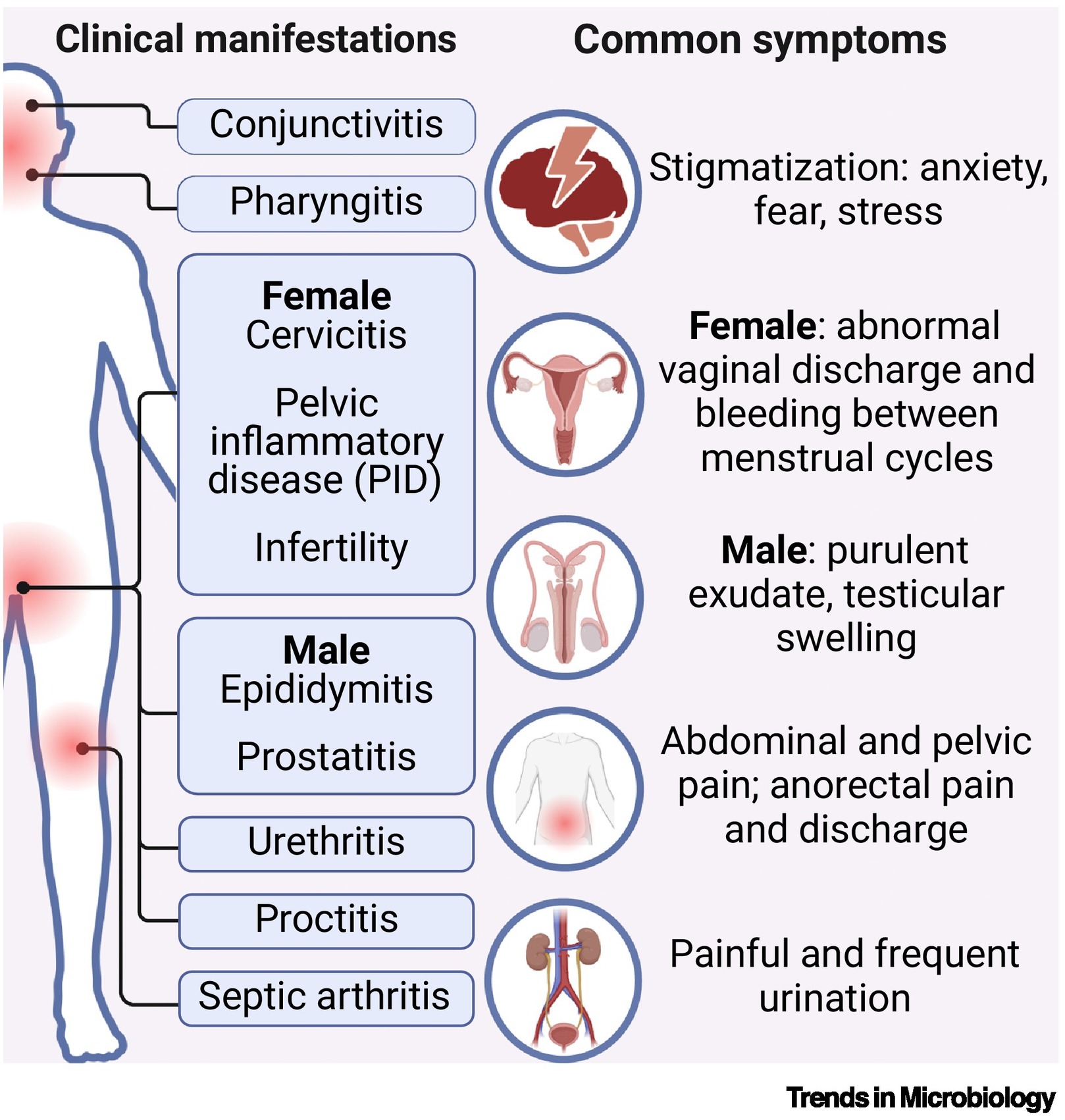
Gonorrhea is caused by the bacterium Neisseria gonorrhea. Gonorrhea is the second most commonly reported sexually transmitted in the United States, following chlamydia. In 2019, there were 616,392 cases of gonococcal infections, corresponding to a rate of 188.4 cases per 100,000 persons. The number of reported cases varies by geography, race, ethnicity, and HIV status. Because many infections are asymptomatic, the true prevalence is probably much higher than reported.
Gonococcal infections in women are often asymptomatic but can cause dysuria, and vaginal discharge. Men often develop symptomatic urethritis, epididymitis, and proctitis. However, the majority of extragenital (eg, pharyngeal, rectal) infections in men are asymptomatic. Symptoms usually occur within 7 days of infection.
Untreated gonococcal infection may progress to pelvic inflammatory disease (PID) in women and epididymitis and prostatitis in men. One to 3% of persons with gonorrhea develops disseminated gonococcal infection, which may be associated with a late-acting complement deficiency (C7-9). Clinical manifestations include bacteremia, skin lesions on the extensor surfaces of the hands and feet, and septic arthritis. Endocarditis and meningitis are rare complications.
Culture used to be the gold standard test for N. gonorrhea infections. Today, nucleic acid amplification testing is considered the standard method because of its higher sensitivity and specificity. One commonly used automated method is the Hologic Aptima Combo 2 Assay that is based on transcription-mediated amplification to detect N. Gonorrhea ribosomal RNA.
Diagnostic testing for gonorrhea is highly accurate for all genitourinary sites in females and males. Site-specific testing for gonorrhea in females has sensitivities of 90% to 98% for endocervical, 98% to 100% for vaginal, and 91% to 100% for urine samples. Specificity was also high for all sites, ranging from 99%-100%. Endocervical and vaginal site testing were most accurate. In females, self- and clinician-collected vaginal samples for gonorrhea testing were both highly sensitive.
Site-specific studies of testing in males indicated sensitivities of 93% to 100% for urine, 100% for meatal, 98% for urethral, 93% for rectal, and 89% for pharyngeal samples. Specificity was >99% for all sites.
Because of the likelihood of asymptomatic infections, screening for gonorrhea is recommended for women at increased risk of infection. Risk factors include: a history of previous gonorrhea or other STI, inconsistent condom use, and multiple sex partners.
References
Berry L, Stanley B. Comparison of self-collected meatal swabs with urine specimens for the diagnosis of Chlamydia trachomatis and Neisseria gonorrhoeae in men: comparative study. J Med Microbiol. 2017;66(2):134-136.
Cantor A, et al, Screening for Chlamydial and Gonococcal Infections Updated Evidence Report and Systematic Review for the US Preventive Services Task Force, MAMA, 2021;362(10):957-966.
Adamson PC, Klausner JD. Diagnostic tests for detecting Chlamydia trachomatis and Neisseria gonorrhoeae in rectal and pharyngeal specimens. J Clin Microbiol. 2022;60(4):1-9.



 How to resolve AdBlock issue?