

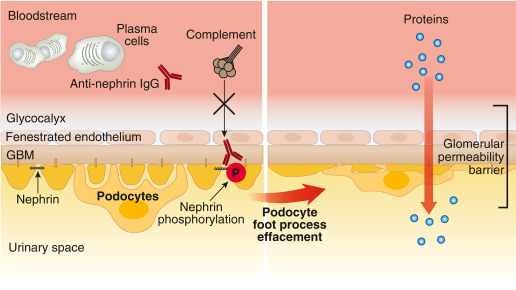
Minimal change disease (MCD) is a common cause of the nephrotic syndrome in children and adults, but the underlying pathogenesis is unclear. In a study of over 60 adults and children with biopsy-proven MCD and no known genetic basis, circulating autoantibodies targeting nephrin were identified in approximately one-third of patients with active disease.
Kidney biopsies form patients with anti-nephrin antibodies, contain punctate immunoglobulin G (IgG) deposits co-localized with nephrin in the glomerular slit diagram. No deposits were seen in patients who were serologically negative.
Nephrin is a cell adhesion molecule, whose extracellular domain interacts with itself and other proteins across the intercellular junction of podocyte foot processes (the slit diaphragm). Nephrin is essential in establishing the 3-dimensional structure of this intercellular junction and its filtration characteristics. Binding of anti-nephrin autoantibodies at the slit diagram induces nephrin-dependent signaling that might result in podocyte effacement and subsequent proteinuria.
Anti-nephrin autoantibody testing is restricted to research laboratories.
References
Watts A, Keller K, Lerner G, et al. Discovery of Autoantibodies Targeting Nephrin in Minimal Change Disease Supports a Novel Autoimmune Etiology. J Am Soc Nephrol 2021.
Hengel FE, et al, Autoantibodies Targeting Nephrin in Podocytopathies, N Eng J Med, 2024;391:422-433.
Fischman CJ, Holzman LB, Identification of Nephrin Autoantibodies Signals New Chapter for Glomerular Disease, Amer J Kid Dis, 2025;85(2):262-265.



 How to resolve AdBlock issue?