

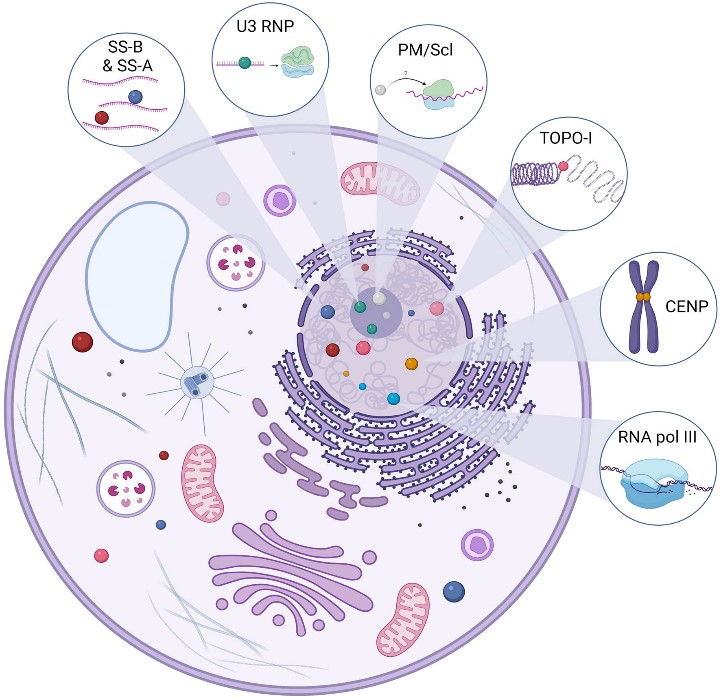
Serologic tests for autoantibodies, including antinuclear antibodies (ANAs) and antibodies to specific nuclear antigens such as double-stranded DNA (dsDNA), play an important role in the diagnosis of systemic rheumatic diseases. However, test results for autoantibodies alone are insufficient to establish the diagnosis of a systemic rheumatic disease. No tests for autoantibodies should be performed without a clinical evaluation that leads to a presumptive diagnosis.
The original discovery of ANA was based on indirect immunofluorescence. Immunofluorescent antibody (IFA) is still the most commonly utilized method for detection of antinuclear antibodies. In this method, diluted patient serum is incubated on a slide containing a monolayer of human epithelial cells. If antibody is present, it binds to cell nuclei. After washing, bound antibody is detected by adding fluorescent anti-human IgG. Positive cells demonstrate bright green nuclear fluorescence with a distinct staining pattern. Patient samples are initially tested at a dilution of 1:40 to 1:160. Positive samples are then diluted and both the fluorescent pattern and titer are reported. The titer is the highest dilution of serum that still shows immunofluorescent nuclear staining.
Hep-2 cells are the preferred cell line due to their human origin, high mitotic activity, and the ability to induce expression of clinically important antigens. HEp-2 cells have an estimated 100 to 150 antigens, the most of any method, allowing for detection of the greatest number of antibody specificities.
Specific follow-up tests for antibodies to the following antigens are available: dsDNA, Sm, RNP, SS-A (Ro), SS-B (La,) Scl-70, histones, and Jo-1. With rare exceptions, these tests should not be ordered if the ANA was negative or weakly positive, because less than 5% of patients with ANA titers <1:160 will have positive follow-up tests.
SS-A/Ro and SS-B/La are distinct small intracellular RNA-protein complexes. Antigenic reactivity resides in the protein components.Tests for antibodies to SS-A/Ro and SS-B/ La are useful in the diagnosis of SLE and Sjogren's Syndrome.
Antibodies to the ribonucleoprotein SS-A (Ro) are detected in 35 to 60% of SLE patients. Anti SS-A autoantibodies have been associated with photosensitivity, sicca symptoms, thrombocytopenia, and subacute cutaneous LE rash. Subacute cutaneous lupus erythematosis is a widespread, non-scarring, often photosensitive, form of cutaneous lupus with mild systemic manifestations and a low frequency of CNS and renal involvement. Anti SS-A (Ro) antibodies are strongly associated with neonatal lupus. Maternal IgG antibodies cross the placenta, causing disease in the neonate. The two major manifestations of neonatal lupus erythematosis are transient dermatitis and permanent heart block. Photosensitive dermatitis develops after the first few weeks of life and resolves within 6 months, coincident with the clearing of maternal antibodies from the infant’s circulation. Heart block is due to binding of SS-A antibodies in conducting system tissue.
Lymphocytic infiltration of exocrine glands, particularly the salivary and lacrimal glands, and other organs characterize Sjogren syndrome. The most common clinical presentation is with sicca symptoms, xerophthalmia and xerostomia. The autoantibodies most closely associated with Sjogren syndrome are directed against the ribonucleoproteins SS-A (Ro) and SS-B (La). SS-A antibodies are detected in 40 to 60% of patients with Sjogren syndrome. SS-B (La) antibodies occur slightly less frequently and never occur in the absence of SS-A antibodies. The presence of SS-A and SS-B antibodies can be used to support the diagnosis of Sjogren syndrome. However, their presence must be interpreted in the proper clinical context because they are also found in patients with SLE and other diseases. In addition to diagnosis, these antibodies provide some prognostic information. Patients with these antibodies more often have extraglandular disease including vasculitis, purpura, lymphadenopathy, leukopenia, thrombocytopenia, hypergammaglobulinemia, and the presence of rheumatoid factor.
SS-A and SS-B antibodies are detected by either a multiplex flow immunoassay (Bioplex) or an enzyme-linked immunosorbent assay (ELISA).
Reference interval using the multiplex flow immunoassay is 0.0-0.9 AI units for each antibody.
Specimen requirement is one red-top or red-top gel barrier tube of blood.
References
Aringer M, Costenbader K, Daikh D, et al. 2019 European League Against Rheumatism/American College of Rheumatology Classification Criteria for Systemic Lupus Erythematosus. Arthritis Rheumatol. 2019;71(9):1400-1412.
Shiboski CH, et al. 2016 American College of Rheumatology/European League Against Rheumatism classification criteria for primary Sjogren's syndrome: A consensus and data-driven methodology involving three international patient cohorts. Ann Rheum Dis. 2017;76(1):9-16.
Brito-Zeron P, et al. Sjogren syndrome. Nat Rev Dis Primers. 2016;2:1604.
Schulte-Pelkum J, Fritzler M, Mahler M. Latest update on the Ro/SS-A autoantibody system. Autoimmun Rev. 2009;8(7):632-637



 How to resolve AdBlock issue?