










Kleihauer Betke by Flow Cytometry
The Kleihauer-Betke test has been used to detect fetal to maternal hemorrhage (FMH) since Dr. Kleihauer’s original publication in 1957. The classical test relies on the principle that red cells containing fetal hemoglobin (HbF) are less susceptible to acid elution than cells containing HbA. A thin smear of maternal blood is exposed to citric acid, which elutes hemoglobin from maternal red cells, resulting in pale ghost cells. Fetal red cells are resistant to acid and retain their hemoglobin. Consequently, they stain pink with erythrosin B dye. The smear is examined microscopically to determine the percentage of fetal red blood cells. This test involves a considerable amount of subjective interpretation.The quality of the stain must be very good so that red cells can be clearly distinguished from leukocytes. Several published studies and proficiency surveys have demonstrated that the precision and accuracy of this method are poor. Variation from laboratory to laboratory is 50% and the rate of fetal cell detection is only 90%.
Flow cytometry can provide a much more accurate measurement of fetal red blood cells in maternal blood. Proficiency surveys have shown this method to be more accurate and precise. The coefficient of variation is <7.5%.
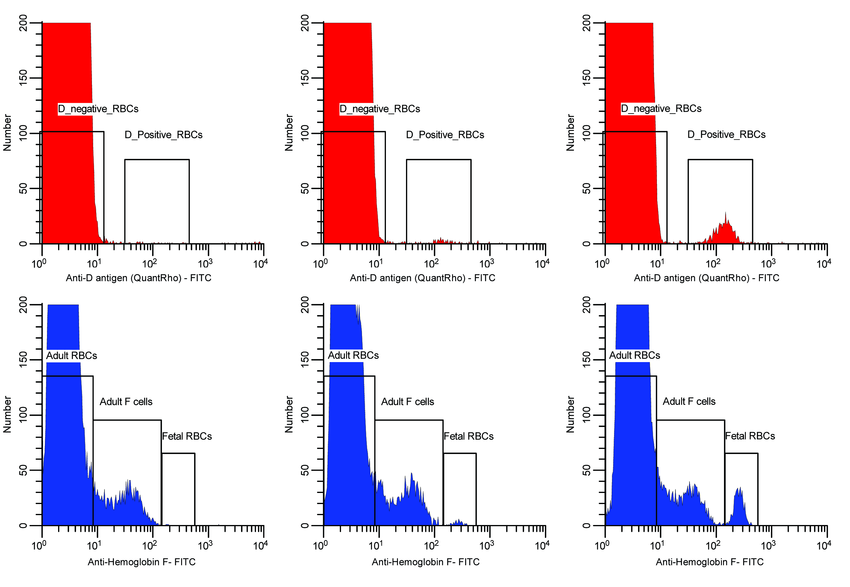
This method utilizes a fluorescently labeled monoclonal antibody to the gamma chain of the HbF molecule (anti-HbF). A sample of whole blood is fixed with glutaraldehyde to crosslink hemoglobin inside the cells and then cell membranes are permeabilized with a detergent to ensure access and binding of anti-HbF. A flow cytometer determines the percentage of fetal cells by analyzing more than 65,000 cells. Fetal red cells are clearly distinguished from adult cells by their significantly higher fluorescent signal. Normal adults exhibit a single peak with minimal fluorescence corresponding to HbA. Neonates have a single peak with bright fluorescence corresponding to HbF. Young infants usually have two peaks, representing both HbA and HbF.
Patients with hereditary persistence of fetal hemoglobin (HPFH) trait have a single peak of intermediate fluorescence. Other conditions with elevated levels of Hb F, such as beta thalassemia and delta-beta thalassemia have two peaks corresponding to a heterocellular pattern.
Specimen requirement for both methods is one lavender (EDTA) tube of maternal blood.
Reference range for the flow method is 0–0.09% fetal cells.
References
Kim YA, Makar RS, Detection of fetomaternal hemorrhage, Am J Hematol, 2012; 87: 417-423.
Australian and New Zealand Society of Blood Transfusion, Guidelines for Laboratory Estimation of Fetomaternal Haemorrhage, 2nd edition, September 2021.

Transfusion for Solid Organ Transplant
Transfusion-associated immunosuppression has been well documented. Suppression of cytotoxic T-lymphocytes may play a role in graft survival. Other suggested mechanisms include the development of anti-idiotype antibodies or pre-transplant selection. Opelz et al found that blood transfusion enhanced renal graft survival. They subsequently demonstrated that this response was transfusion dose-dependent and white cell-depleted red cells were less effective in promoting graft survival. These results led to the consideration of blood transfusion as a strategy to improve graft survival in transplant recipients. With the rapid improvement in immunosuppression therapy, the additional effect of transfusion became marginal. The practice of infusion of one unit of donor’s blood preoperatively for immunomodulation is no longer practiced.
ABO grouping is still the primary test for organ donation and transplantation. The first and foremost step in graft rejection is the binding of anti-A and anti-B antibodies to endothelial cells. This binding initiates a cycle of complement fixation, vascular damage, and thrombosis that leads to ischemia and rejection. ABO incompatible liver transplants are less susceptible to hyper-acute rejection than are other organs but the risk of eventual rejection is still high.
Matching for Class 1 and Class 2 major histocompatibility antigens (A, B, and DR) is associated with significant improvement in graft survival after heart, kidney and pancreas transplantation, even with the use of immunosuppressant drugs. Kidney and pancreas transplants, together or separate, must be HLA Class I (T lymphocyte) crossmatch-compatible. HLA matching is rarely undertaken for liver transplantation because early studies failed to show any benefit in graft survival.
Non-hepatic transplant candidates are evaluated for a history of HLA exposure through pregnancy, transfusion, or prior transplant. Among patients who are waiting for a kidney transplant in the U.S., approximately 14% are sensitized to HLA antigens due to exposures from prior transplants, transfusions or pregnancies.
Primary cardiac transplant without prior cardiac surgery poses less risk of alloimmunization toward HLA or red cell antigens. After prior coronary artery bypass surgery, leukocyte antibodies have been found in 10 to15% and red cell antibodies in 3 to 5% of patients. Heart transplantation requires similar transfusion support as coronary artery bypass surgery. In primary transplants, 0 to 2 units of red cells are required. Twice this amount is generally needed when there has been prior surgery. In particular, patients who have left ventricular assist devices (LVADs) implanted as a bridge to transplantation need multiple blood components and approximately 30% develop HLA antibodies, reducing the chance of a cross match-negative graft. DR-shared heart transplants have a better outcome than DR-mismatched grafts
HLA antibodies formed in the recipients against the transplanted organ play a major role in the graft rejection. These antibodies should be removed from the recipient’s circulation as far as possible. Options for antibody depletion in sensitized patients include plasma exchange with or without antibody adsorption columns; intravenous immunoglobulin (IVIG); monoclonal antibodies, e.g. rituximab; and other immunosuppressive drugs.
HLA antigens are present on both platelets and white blood cells. RBCs do not express HLA antigens, but Bennett-Goodspeed antigens may occasionally be present and lead to HLA alloimmunization. Today, all RBC transfusions are leukocyte reduced. Leukocyte reduced RBC units reduces the incidence of febrile nonhemolytic transfusion reactions and transmission of leukotropic viruses such as CMV.
Even though leukocyte reduction filters remove 99.9% of white blood cells, leukocyte reduced RBC units still may contain up to 5 million lymphocytes and stimulate HLA antibody formation against Class 1 and Class 2 HLA epitopes. Apheresis platelet transfusions contain less than 5 million lymphocytes and are considered to be leukocyte reduced. Transfusion of platelets may lead to formation of HLA antibodies directed against Class 1 HLA epitopes. HLA sensitization from transfusion is less robust and generally shorter lived than sensitization from transplantation. However, regardless of the route of sensitization, IgG HLA antibodies to a transplanted organ negatively impact graft function and survival. The use of these leukocyte-reduced products should be restricted for prospective renal and heart transplant patients.
Patients who are transfused while on the waiting list for a solid organ transplant are more likely to form HLA antibodies. Transfusion increases the breadth and strength of HLA antibodies in sensitized patients. Transfusion can increase patients' calculated panel reactive assay (cPRA) and make it more difficult to find compatible donor organs. The University of Minnesota reported in 2017 that approximately 25% develop at least one additional high threshold HLA antibody. Patients that developed HLA antibodies with MFI>3000 had a greater risk of treatment for rejection within the first post-transplant year.
CMV seronegative patients receiving seronegative organs should receive CMV safe blood products (leukocyte-reduced or from CMV seronegative donors). There is no documented benefit to providing CMV safe products to patients who are already CMV seropositive.
Transfusion-associated graft vs. host disease is rare (only 4 published cases) despite immune suppression. Therefore routine irradiation of blood components for solid organ transplants is not recommended on a routine basis. Irradiation of RBCs damages cell membranes and increases potassium leakage, which can increase the risk of hyperkalemia, especially in patients with poor renal function and metabolic acidosis.
HLA Matching of Blood Components for Solid Organ Transplant Recipients
Transfusion-associated immunosuppression has been well documented. Suppression of cytotoxic T-lymphocytes may play a role in graft survival. Other suggested mechanisms include the development of anti-idiotype antibodies or pre-transplant selection. Prior to the era of immunosuppressive drugs, clinical studies found that blood transfusion enhanced renal graft survival. This response was transfusion dose-dependent and white cell-depleted red cells were less effective in promoting graft survival. These results led to the consideration of blood transfusion as a strategy to improve graft survival in transplant recipients. With the rapid improvement in immunosuppression therapy, the additional effect of transfusion became marginal. The practice of infusion of one unit of donor’s blood preoperatively for immunomodulation is no longer practiced.
ABO grouping is still the primary test for organ donation and transplantation. The first and foremost step in graft rejection is the binding of anti-A and anti-B antibodies to endothelial cells. This binding initiates a cycle of complement fixation, vascular damage, and thrombosis that leads to ischemia and rejection. ABO incompatible liver transplants are less susceptible to hyper-acute rejection than are other organs but the risk of eventual rejection is still high.
Matching for Class 1 and Class 2 major histocompatibility antigens (A, B, and DR) is associated with significant improvement in graft survival after heart, kidney and pancreas transplantation, even with the use of immunosuppressant drugs. Kidney and pancreas transplants, together or separate, must be HLA Class I (T lymphocyte) crossmatch-compatible. HLA matching is rarely undertaken for liver transplantation because early studies failed to show any benefit in graft survival.
Non-hepatic transplant candidates are evaluated for a history of HLA exposure through pregnancy, transfusion, or prior transplant. Among patients who are waiting for a kidney transplant in the U.S., approximately 14% are sensitized to HLA antigens due to exposures from prior transplants, transfusions or pregnancies.
Primary cardiac transplant without prior cardiac surgery poses less risk of alloimmunization toward HLA or red cell antigens. After prior coronary artery bypass surgery, leukocyte antibodies have been found in 10 to15% and red cell antibodies in 3 to 5% of patients. Heart transplantation requires similar transfusion support as coronary artery bypass surgery. In primary transplants, 0 to 2 units of red cells are required. Twice this amount is generally needed when there has been prior surgery. In particular, patients who have left ventricular assist devices (LVADs) implanted as a bridge to transplantation need multiple blood components and approximately 30% develop HLA antibodies, reducing the chance of a cross match-negative graft. DR-shared heart transplants have a better outcome than DR-mismatched grafts
HLA antibodies formed in the recipients against the transplanted organ play a major role in the graft rejection. These antibodies should be removed from the recipient’s circulation as far as possible. Options for antibody depletion in sensitized patients include plasma exchange with or without antibody adsorption columns; intravenous immunoglobulin (IVIG); monoclonal antibodies, e.g. rituximab; and other immunosuppressive drugs.
HLA antigens are present on both platelets and white blood cells. RBCs do not express HLA antigens, but Bennett-Goodspeed antigens may occasionally be present and lead to HLA alloimmunization. Today, all RBC transfusions are leukocyte reduced. Leukocyte reduced RBC units reduces the incidence of febrile nonhemolytic transfusion reactions and transmission of leukotropic viruses such as CMV.
Even though leukocyte reduction filters remove 99.9% of white blood cells, leukocyte reduced RBC units still may contain up to 5 million lymphocytes and stimulate HLA antibody formation against Class 1 and Class 2 HLA epitopes. Apheresis platelet transfusions contain less than 5 million lymphocytes and are considered to be leukocyte reduced. Transfusion of platelets may lead to formation of HLA antibodies directed against Class 1 HLA epitopes. HLA sensitization from transfusion is less robust and generally shorter lived than sensitization from transplantation. However, regardless of the route of sensitization, IgG HLA antibodies to a transplanted organ negatively impact graft function and survival. The use of these leukocyte-reduced products should be restricted for prospective renal and heart transplant patients.
Patients who are transfused while on the waiting list for a solid organ transplant are more likely to form HLA antibodies. Transfusion increases the breadth and strength of HLA antibodies in sensitized patients. Transfusion can increase patients' calculated panel reactive assay (cPRA) and make it more difficult to find compatible donor organs. The University of Minnesota reported in 2017 that approximately 25% develop at least one additional high threshold HLA antibody. Patients that developed HLA antibodies with MFI>3000 had a greater risk of treatment for rejection within the first post-transplant year.
CMV seronegative patients receiving seronegative organs should receive CMV safe blood products (leukocyte-reduced or from CMV seronegative donors). There is no documented benefit to providing CMV safe products to patients who are already CMV seropositive.
Transfusion-associated graft vs. host disease is rare (only 4 published cases) despite immune suppression. Therefore routine irradiation of blood components for solid organ transplants is not recommended on a routine basis. Irradiation of RBCs damages cell membranes and increases potassium leakage, which can increase the risk of hyperkalemia, especially in patients with poor renal function and metabolic acidosis.
Zika Virus Blood Donor Screening
Zika Virus (ZIKV) is an enveloped, single-stranded RNA arbovirus in the Flaviviridae family (genus Flavivirus), closely related to dengue virus (DENV) and West Nile virus (WNV). Like DENV and chikungunya virus (CHIKV), ZIKV is primarily transmitted by Aedes mosquitoes, most commonly Aedes aegypti.
ZIKV outbreaks have occurred on Yap Island, Micronesia in 2007, French Polynesia in 2013-2014, and the Americas in 2015. The largest outbreaks occurred in Brazil and Colombia in 2016, eventually expanding to at least 91 countries in 2018. The first local mosquito-borne transmission of ZIKV in the United States (U.S.) was reported from Puerto Rico in December 2015, and soon thereafter in American Samoa and the U.S. Virgin Islands. An estimated 13% of the population of Puerto Rico was infected during the 2016 outbreak.
Local mosquito-borne transmission of ZIKV was reported in Florida in July 2016 and in Texas in November 2016. Currently, there are no areas of increased risk for ZIKV transmission in the continental U.S., but the possibility of reintroduction of ZIKV by infected individuals exists in states and territories where Aedes aegypti, and possibly Aedes albopictus mosquitoes exist. ZIKV infection was also documented during the outbreaks to occur through other routes of exposure, including perinatal, intrauterine, sexual, laboratory-acquired and blood-borne transmission. More than 60% of men with symptomatic ZIKV infection have detectable ZIKV RNA in their semen during the first 30 days of onset of illness, with the longest recorded duration of 281 days in one man.
Most people infected with ZIKV are asymptomatic or have only mild symptoms such as fever, maculopapular rash, headache, arthralgia, and conjunctivitis that last up to a week. However, ZIKV infection can occasionally be associated with Guillain-Barré syndrome and severe neurological complications. ZIKV infection during pregnancy can cause microcephaly, severe congenital defects, and infant death.
ZIKV may be detected in serum or plasma for 1to 2 weeks after infection and has been detected for longer periods of time in Whole Blood, red blood cells (RBCs), semen, and urine. ZIKV RNA persists in RBCs and Whole Blood for several months following clearance in plasma and other body fluids. In a study of 150 ZIKV infected individuals in Puerto Rico, the median values for ZIKV RNA persistence were 11-17 days in serum; 6-10 days in urine; and 28-41 days in semen.
The Food and Drug Administration issued its final guidance on Zika virus testing in July, 2018. The guidance states that all blood donations collected in the U.S. and its territories must be tested with a licensed nucleic acid test (NAT) for ZIKV using either mini-pool (MP) NAT or individual donor (ID) NAT. Two FDA licensed test systems are now available for ZIKV NAT; Cobas Zika Virus test on the Cobas 6800 and 8800 sytems and Procleix on the Procleix Panther.
FDA recommends switching from MP NAT to ID NAT, even in the absence of ZIKV- reactive donations, when CDC or state or local health departments identify an area at increased risk for ZIKV transmission that affects a defined geographic collection area. In the event of a ZIKV reactive donation, blood collection establishments should convert to ID NAT within 24 hours of obtains the positive test result.
As an alternative to testing, FDA allows blood establishments to use FDA-approved pathogen reduction technology for platelets and plasma to reduce the risk of ZIKV transmission.
FDA does not recommend pre-donation assessment for ZIKV risk factors for donors of blood and blood components because; most infected persons and their sexual partners are unaware of their risk, the infection is usually asymptomatic, appropriate testing strategies are available travel deferrals are complicated to implement. FDA continues to recommend pre-donation assessment for donors of human cells, tissues, or cellular or tissue-based products (HCT/Ps).
References
Revised recommendations for reducing the risk of Zika virus transmission by blood and blood components: Guidance for industry. https://www.fda.gov/downloads/BiologicsBloodVaccines/GuidanceComplianceRegulatoryInformation/Guidances/Blood/UCM518213.pdf
Petersen, L.R., et al., Zika virus. N Engl J Med 2016; 374(16):1552-63
Motta, I.J.F., et al., Evidence for transmission of Zika virus by platelet transfusion. N Engl J Med 2016; 375:1101-3.
Berlaire, D., et al., Zika virus and blood transfusion: the experience of French Polynesia. Transfusion 2017; 57:729-733.
Mead PS, Duggal NK, Hook SA, Delorey M, et al., Zika virus shedding in semen of symptomatic infected men. New Eng J Med 2018;378:1377-1385.
Aubry M, Richard V, Green J, et al. Inactivation of Zika virus in plasma with amotosalen and ultraviolet A illumination. Transfusion 2016;56:33-40.
Santa Maria, F., et al., “Inactivation of Zika virus in platelets with amotosalen and ultraviolet A illumination.” Transfusion 2017; 57:2016-2025.
Informed Consent for Transfusion
Transfusion of blood and blood components is one of the most commonly performed hospital procedures in the United States. Transfusions can be lifesaving, but are also associated with serious infectious and non-infectious risks. Patients requiring blood transfusion need to be fully informed about the potential benefits and risks.
Informed consent should be obtained prior to all blood and blood product transfusions, except in emergency situations. Informed consent for blood transfusion is a requirement of The Joint Commission as well as AABB (formerly the American Association of Blood Banks). Specifically, AABB standards indicates that at a minimum, elements of consent shall include all of the following:
- A description of the risks, benefits, and treatment alternatives (including nontreatment)
- The opportunity to ask questions
- The right to accept or refuse transfusion
In order to be legally valid, the following elements of informed consent must be present:
- The patient must be competent.
- The treating provider, or the treating team, who decides that the transfusion is necessary is the only person(s) who may obtain the consent.
- The provider must explain the procedure in terms and language that the patient understands.
- The patient should be informed of common risks and serious uncommon risks of transfusion, potential benefits of transfusion, alternatives to transfusion and risks if declining transfusion.
- The patient must have the opportunity to ask questions.
- The patient must have the opportunity to make an uncoerced choice.
- The provider should document the discussion.
Practical Issues Regarding Informed Consent
Consent for nonemergent transfusion does not have to be obtained before each individual transfusion of blood or blood products but should be obtained when management decisions are made. For inpatients, consent is valid throughout the entire hospital stay. For outpatients, consent may be valid as long as the clinical situation or treatment plan has not changed, which is usually up to one year.
If a patient is incompetent by age or mental status, and if the patient’s wishes regarding transfusion are not known, consent should be sought from the parent or legal guardian.
If no one is available to provide consent and the need for transfusion is considered a medical emergency, blood components may be administered based on the doctrine of implied consent. The emergent need for transfusion should be carefully documented in the medical record.
Common risks of allogeneic transfusion include fever, chills, hives and pruritis. Uncommon serious risks include circulatory overload, hemolysis, sepsis, or infection with HIV, Hepatitis B and C viruses and other microorganisms.
Alternatives to transfusion include autologous donation, directed donation, drug therapy, and intraoperative salvage of blood. When applicable, the consent and discussion should occur well in advance of any elective procedure, so that the alternatives may be obtained if the patient desires.
References
Goldman, E. Legal Considerations for Allogeneic Blood Transfusion. American Journal of Surgery, 170 (6A Suppl), Dec 1995,p.27S.
Sazama, K. Practical Issues in Informed Consent for Transfusion. American Journal of Clinical Pathology, 107(4 Suppl 1), Apr 1997, p.S72.
Exchange Transfusion for HDN
Exchange transfusion is performed for neonates with hemolytic disease of the newborn when bilirubin is rising high enough, in spite of phototherapy, to increase the risk of encephalopathy. A double-volume red cell exchange will remove 85-90% of the antibody-coated fetal red cells and up to 50% of the circulating bilirubin. It may also reduce the risk of needing a second exchange transfusion. To minimize the risk of hyperkalemia, the red cell component should be less than 5 days from donation. The product may be irradiated at any time within that window of time, but must be used within 24 hours of irradiation. The hematocrit of the component should range from 50 to 60% to reduce risk of both post-exchange anemia and polycythemia. This is achieved by removing plasma from the unit to achieve the desired hematocrit. For intrauterine transfusions, the desired hematocrit of the transfused product is 70 to 80%.
References:
- European Directorate for the Quality of Medicines, (2015). Guide to the preparation, use and quality of assurance of blood components, EDQM.
- New, H. V., J. Berryman, P. H. B. Bolton-Maggs, C. Cantwell, E. A. Chalmers, T. Davies, R. Gottstein, A. Kelleher, S. Kumar, S. L. Morley, S. J. Stanworth and H. the British Committee for Standards in (2016). "Guidelines on transfusion for fetuses, neonates and older children." British Journal of Haematology 175(5): 784-828.
Blood Product Lookback
Blood components are regulated by FDA as drugs and are subject to recalls and market withdrawals. Strict donor screening and infectious disease testing during donations keep the number of such events down to a very small percent of total collections.
When such events happen, the FDA regulations (21 CFR 610.46-48 and 42 CFR 482.27(c)) and AABB standards require that blood collection agencies notify hospitals (transfusion services). Recalls and market withdrawals are needed when donors are subsequently found to have or to be at risk for transmissible disease (positive infectious disease marker or high risk behavior) or later recalled information that would have rendered them ineligible at the time of donation (e.g. history of a prior malignant condition, risk of CJD, travel to a malaria endemic area, medications, tattoo, etc). In both situations, the donor is apparently well and had negative infectious disease testing at the time of donation.
Look-back refers to the process of identifying the location and/or final disposition of components from a particular donor, and removing from inventory any components that are potentially infectious or harmful. For components that were transfused, the recipient is identified so that, if indicated, appropriate treatment and/or counseling can be provided.
The regulations mandate the following responsibilities of the physician regarding recipient notification for possible HIV or HCV exposure:
- Notify the patient, either verbally or in writing, that they received a unit, potentially infected with HIV/HCV and of the need for HIV/HCV testing and counseling. This information should be sufficient for the patient to make an informed decision about whether to obtain testing and how/where to obtain counseling.
- If the patient is judged incompetent by a state court, the physician should notify a legal representative designated in accordance with state law.
- If the patient is a minor (at the time of notification), the physician should notify the patient’s legal representative or a relative.
- If the patient is deceased, the regulations require that the patient’s legal representative or relative be informed (Only for HIV).
For other look-back instances, the notification is not mandated. The ordering physician can determine the need for medically appropriate notification, patient counseling and additional testing.
The legal and ethical responsibility of notifying the patient falls on the ordering physician because this physician has taken into account the risk associated with transfusion before obtaining consent and ordering blood components. In cases where the ordering physician cannot be contacted, the primary care physician or the physician who most recently saw the patient
Hereditary Angioedema Therapy
Hereditary angioedema is characterized by unpredictable recurrent attacks of subcutaneous or submucosal swellings. Patients present with well circumscribed, nonitching edema of upper airway, face, extremities, genitals and gastrointestinal system. Angioedema of the larynx can be life-threatening. Attacks have a slow onset and may last between 2 and 5 days.
Prevalence is estimated to be one in 10,000 individuals. There are two forms of C1 esterase inhibitor deficiency. The inherited form is usually detected in the first or second decade of life and has an autosomal dominant pattern of inheritance. The acquired form primarily affects adult or elderly patients with autoimmune or lymphoproliferative disorders. (See article on C1 esterase inhibitor).
Hereditary angioedema is caused by a deficiency or dysfunction of C1 esterase inhibitor that results in loss of inhibition of plasma kallikrein, leading to increased cleavage of high-molecular-weight kininogen and the release of bradykinin. Bradykinin increases local capillary permeability, resulting in angioedema.
Management of angioedema consists of treatment of acute attacks and longer term prophylaxis. In the past, acute attacks in adults were usually treated by transfusion of 2 units of fresh frozen plasma. If necessary, additional units were transfused until the patients' symptoms resolved. Some patients experienced a paradoxical worsening of symptoms.
In 2009, FDA approved Berinert (CSL Behring) for the treatment of acute abdominal, facial or laryngeal attacks of hereditary angioedema in children and adults. This is a plasma derived, nanofiltered, lyophilized concentrate of C1 esterase inhibitor. Recommended dose is 20 U/kg. Relief from symptoms occurs begins to occur in approximately 30 minutes. Complete resolution usually occurs within 5 hours. Berinert is well tolerated in most patients.
Current prophylactic options for hereditary angioedema include attenuated androgens, fibrinolytic agents, and intravenous C1 esterase inhibitors. Anabolic steroids such as danazol, stanozolol, and oxandrolone probably work by increasing intrinsic C1 inhibitor production and promoting bradykinin degradation through an increase in aminopeptidase P. They show good efficacy at higher doses. However, adverse effects are common, and androgens are contraindicated in pregnancy and for prepubertal children. Tranexamic acid is a popular option for children but has poor efficacy. Cinryze is a C1 esterase inhibitor approved by FDA for routine prophylaxis against angioedema attacks in adolescent and adult patients. It is a highly purified, pasteurized and nanofiltered plasma-derived C1 esterase inhibitor. Recommended dose is 1000 units given IV over 10 minutes; dosing can be repeated every 3 to 4 days. Cinryze decreases the frequency, severity and duration of angioedema attacks, but requires intravenous access via an indwelling port. Ecallantide (Kalbitor, Dyax), is a potent inhibitor of kallikrein production that is administered subcutneously. Time to improvement of symptoms averages about 2 hours. Anaphylaxis has been reported in approximately 3% of patients.